


The Role of Public Work Contractors in Infrastructure


Most people assume a public work contractor simply builds things for the government. That assumption misses about 80% of the actual job. The role of public work contractors covers a dense web of regulatory compliance, bonding requirements, prevailing wage obligations, subcontractor oversight, and long-term maintenance accountability. Whether you are a contractor trying to break into public work, an organization evaluating bids, or simply trying to understand what public work contracting actually involves, the details matter far more than most realize.
Table of Contents
Key takeaways
Point | Details |
Compliance is non-negotiable | Federal prevailing wage rules apply to contracts as low as $2,000, making regulatory preparation critical from day one. |
Public vs. private work differs fundamentally | Government funding provides payment security, but compliance standards, audit requirements, and margin profiles are entirely different. |
Fixed-price contracts shift financial risk | Federal policy now favors fixed-price and performance-based structures, increasing cost discipline demands on contractors. |
Maintenance obligations are often underestimated | Post-construction maintenance contracts carry prevailing wage and bonding obligations that many contractors fail to price correctly. |
Smaller opportunities are the real entry point | Most accessible public work projects are under $5 million, sourced from fragmented portals rather than high-profile federal boards. |
The role of public work contractors explained
A public work project is any construction, repair, demolition, or improvement funded with public money and serving a public purpose. Think roads, bridges, schools, water treatment facilities, public housing, and government buildings. The contractor hired to deliver that work is a public work contractor.
What makes the role distinctive is not the physical work itself. It is the accountability structure layered on top of it. Public work contractors are not just building or repairing publicly funded infrastructure. They are also managing compliance with federal, state, and local regulations simultaneously, which creates a level of administrative responsibility that has no real equivalent in private construction.
The responsibilities of public contractors begin before the first shovel breaks ground. Registration and licensing must be current. Bonds must be in place. Prevailing wage determinations must be reviewed and incorporated into bid pricing. Subcontractors must be verified. Documentation must be maintained for potential audits.
Federal prevailing wage requirements apply to contracts as low as $2,000, with mandatory bonding typically triggered at $100,000 contract value. Most contractors are surprised at how low that threshold is. Missing these requirements is not a paperwork issue. It can mean contract termination, fines, or debarment from future bids.
Key responsibilities include:
Registering with the appropriate state and federal agencies before bidding
Verifying that all subcontractors hold current and valid registrations
Paying workers at the prevailing wage rate established for the project location and trade
Submitting certified payroll records to the contracting agency on schedule
Maintaining performance and payment bonds sized to the contract value
Managing project documentation for retainage, change orders, and closeout compliance
Pro Tip: Before you price any public work bid, request the prevailing wage determination directly from the contracting agency. Rates vary by county and trade classification, and using the wrong rate in your labor estimate can make a profitable contract instantly unprofitable.
Legislative changes also affect registration processes. In New Jersey, for example, joint ventures can now bid on public work without registering the joint venture entity before submission. Individual partners must still be registered, but the JV entity itself only needs registration after award. This reduces administrative friction significantly while maintaining compliance standards.
How public work differs from private construction
Understanding what is public work contracting requires understanding what makes it structurally different from private sector work. The differences run deeper than who signs the check.
Factor | Public work | Private construction |
Funding source | Government budgets and taxpayer funds | Private capital, lenders, developers |
Payment security | Very high, government-backed | Variable, depends on client solvency |
Regulatory requirements | Extensive, multi-layered | Fewer, primarily local building codes |
Prevailing wage | Required on qualifying contracts | Not required |
Bonding requirements | Mandatory at defined thresholds | Negotiated, often optional |
Profit margins | 5 to 10% net for general contractors | Higher potential, but greater bad debt risk |
Contract type | Often fixed-price or unit-price | More negotiable, including cost-plus |
Transparency | Public bid process, open records | Private, no disclosure obligation |
Public infrastructure contractors generally earn lower profit margins than private sector work, with general contractors averaging 5 to 10% net and specialty subcontractors ranging from 10 to 18%. The tradeoff is stability. Government clients do not go bankrupt mid-project. Multi-year pipeline visibility is real. Bad debt is essentially nonexistent.
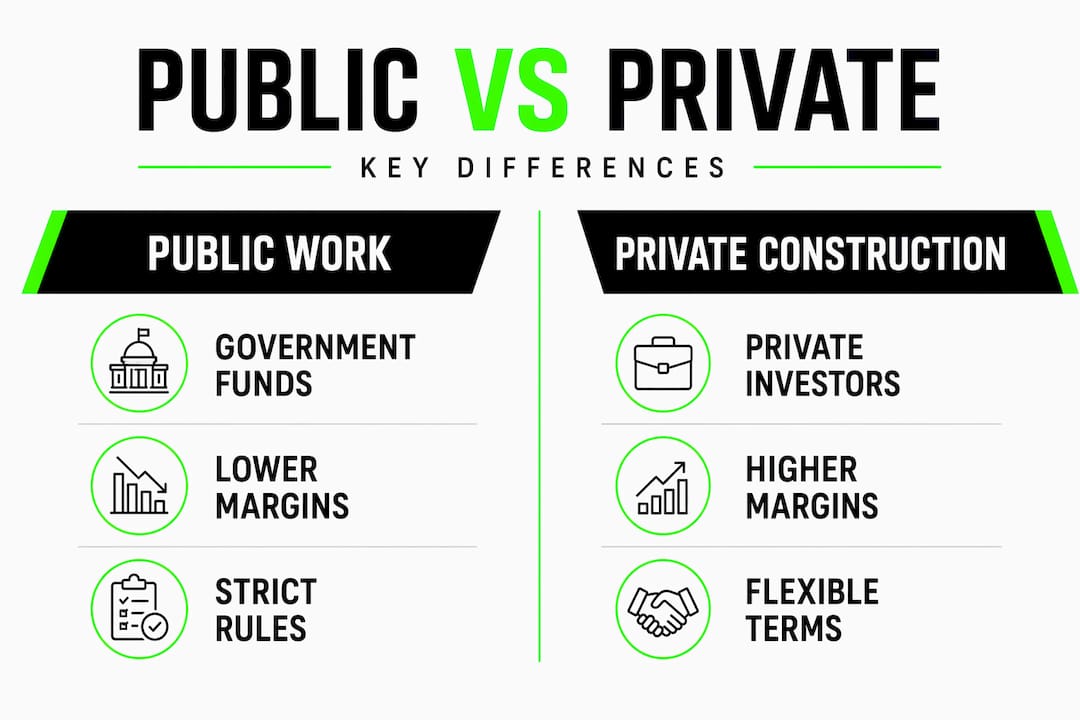
Private construction can offer higher margins, but the risk profile is very different. A developer can run out of funding. A private client can dispute payments for months. Public work contractors accept tighter margins in exchange for a more predictable operating environment. For firms focused on residential versus commercial construction, understanding where public work fits in that spectrum helps with strategic planning.
Project management challenges in public work
The functions of public work contractors extend well beyond construction execution. Managing a public work project means managing risk at every stage, and that risk environment has become more demanding in recent years.

Input costs surged dramatically in 2026, with materials costs increasing more over a four-month span than they had over the previous three years combined. For contractors locked into fixed-price public contracts, that volatility is absorbed internally. There is no mechanism to pass sudden cost increases to a government client the way you might renegotiate with a private developer.
Federal policy is making this harder, not easier. A new executive order mandates greater use of fixed-price structures in federal contracting, pushing toward design-build and public-private partnership models. These structures transfer financial risk directly to the contractor and demand tighter cost control at the estimating stage.
Key risk factors public work contractors must manage include:
Supply chain volatility: Material lead times and price fluctuations can undermine fixed-price contract margins if not built into bids with appropriate contingencies.
Bonding capacity limits: A contractor’s bonding capacity limits how much public work they can hold simultaneously, which directly caps growth without deliberate capacity building.
Compliance timelines: After a joint venture is awarded a contract, registration deadlines compress quickly. Failure to comply can result in contract termination and debarment risk.
Subcontractor failures: The prime contractor remains liable even when a subcontractor causes a compliance failure or work deficiency.
Design-build accountability: Under design-build models, the contractor carries responsibility for both design errors and construction failures, a significant expansion of traditional contractor liability.
Public work contracting rewards contractors who price risk honestly and penalizes those who cut corners on compliance. The regulatory structure is not bureaucratic noise. It is the framework that protects public funds, and contractors who treat it that way tend to build better long-term relationships with agencies.
Pro Tip: When bidding fixed-price public contracts during volatile markets, consider including material escalation clauses in your bid documentation where the agency allows it. Not every agency will accept them, but some will, and that protection can be the difference between a profitable project and a loss.
Practical steps for engaging with public work projects
How public work contractors contribute to infrastructure starts with finding the right opportunities and building the capacity to compete for them. The process is more systematic than most contractors initially expect.
Most accessible public work projects for small and mid-sized firms are under $5 million, distributed across fragmented municipal, county, and state agency portals rather than a single centralized board. Success depends on monitoring multiple sources consistently.
Here is a practical approach to entering and competing in public work:
Register before you need to bid. Every state has its own public work contractor registration system. Get registered now, not when an opportunity appears. Registration lapses or pending applications will disqualify bids automatically.
Monitor multiple bid portals simultaneously. Do not rely on a single state or federal procurement site. County portals, municipal websites, and transit agency boards all post independent opportunities. Set up alerts where portals allow it.
Build your bonding capacity deliberately. The SBA Surety Bond Guarantee Program supports contractors who lack bonding capacity, covering up to $10 million or $20 million on qualifying federal contracts. Use it to access projects while building your surety relationship organically.
Price compliance costs into every bid. Certified payroll administration, prevailing wage verification, and bonding premiums all have real costs. Contractors who treat these as overhead and skip pricing them accurately end up subsidizing compliance from their margins.
Evaluate joint venture opportunities strategically. Partnering with a registered firm that holds complementary licenses or bonding capacity can open projects that neither partner could pursue alone. Structure agreements carefully and confirm all partners meet state registration requirements before submitting.
Leverage small business and emerging contractor programs. Many state transportation and infrastructure agencies maintain DBE (Disadvantaged Business Enterprise) programs, MWBE certifications, and SBA 8(a) pathways that create dedicated bid opportunities for qualifying contractors.
Pro Tip: When forming a joint venture for a public bid, get legal review of the partnership agreement before submitting. The compliance clock starts at award, and ambiguous agreements about who handles registration, bonding, and payroll create problems exactly when you have the least time to resolve them.
Maintenance obligations after construction is complete
One area where the importance of public work contractors is consistently underestimated involves what happens after initial construction. Many public work contracts include ongoing maintenance obligations, and those obligations carry the same regulatory weight as the original construction scope.
Contracted maintenance on public works triggers prevailing wage, bonding, and retainage obligations in most jurisdictions, and the distinction between “ordinary maintenance” performed by municipal employees and “contracted maintenance” performed by an outside firm is legally significant. Ordinary maintenance does not trigger these requirements. Contracted maintenance does.
Contractors who fail to account for this distinction when pricing maintenance contract renewals often find themselves absorbing compliance costs that were never included in their original pricing models. In cases where the maintenance obligations are extensive, that mispricing can become a serious financial problem.
Maintenance obligation | Regulatory trigger | Common oversight |
Prevailing wage on maintenance labor | Applies to contracted work, not staff | Failure to classify work correctly |
Bonding on maintenance contracts | Required at applicable contract thresholds | Assuming construction bond carries over |
Retainage on maintenance work | May apply depending on contract terms | Missing retainage release documentation |
Certified payroll submissions | Required throughout maintenance period | Stopping submissions after construction closeout |
Subcontractor compliance verification | Ongoing throughout maintenance scope | Only verifying at project start |
The long-term performance record of a public work contractor is built as much during maintenance phases as during initial construction. Agencies track contractor performance across the full contract lifecycle, and poor maintenance execution affects future bid evaluations.
What I’ve learned from years in public contracting
I’ve worked on enough public projects to say this directly: the contractors who struggle most in public work are the ones who treat compliance as a separate task from construction. It is not. Regulatory requirements are part of the work, built into the schedule and the budget from the first day of estimating.
The shift toward fixed-price and performance-based contracts is the most significant operational change I’ve seen in recent years. It has forced a level of cost discipline at the bid stage that simply did not exist in more forgiving contract structures. Contractors who do not price risk properly going in will absorb those losses themselves, with no recourse.
I’ve also seen joint ventures done both well and badly. Done well, a JV opens doors neither partner could reach independently. Done badly, it creates administrative chaos at the worst possible moment, right after award when compliance timelines are tightest. The paperwork matters. Get it right before you submit.
The most overlooked long-term opportunity in public work is the relationship with the agency itself. Agencies are not just clients. They are recurring sources of work, referrals, and reputation. Contractors who manage public works projects with transparency and consistency become preferred partners. That trust takes years to build and is worth more than any single contract.
— DJ
Work with a contractor who understands public and private project demands
Djcustomcontracting has been delivering full-service general contracting solutions since 2018, with direct experience across public work, interior renovations, exterior upgrades, additions, alterations, and commercial maintenance. Every project is managed in compliance with applicable building codes, licensing requirements, and insurance regulations so you never have to wonder if the work meets the standard.

Whether you need a contractor for a commercial renovation project that meets agency specifications, an interior renovation for a publicly occupied facility, or a full-scope general contracting partner for your next infrastructure project, Djcustomcontracting brings the experience and compliance knowledge the work demands. No job is too large or too small. Contact Djcustomcontracting today to discuss your project and get a competitive assessment from a team that knows public work from the inside.
FAQ
What is a public work project?
A public work project is any construction, repair, improvement, or maintenance work funded with government money and intended for public use, such as roads, bridges, schools, or municipal buildings.
What is public work contracting?
Public work contracting is the process by which government agencies hire private contractors to complete publicly funded construction or maintenance projects, subject to regulatory compliance requirements including prevailing wage and bonding rules.
What are the main responsibilities of public contractors?
Public contractors are responsible for completing the contracted scope of work, maintaining prevailing wage compliance, submitting certified payroll records, securing required bonds, verifying subcontractor registrations, and managing documentation through project closeout.
How do public work contractors differ from private construction contractors?
Public work contractors operate under stricter regulatory frameworks, including mandatory bonding and prevailing wage requirements, while benefiting from government-backed payment security and lower bad debt risk compared to private sector clients.
Do maintenance contracts in public works require prevailing wage compliance?
Yes. Contracted maintenance on public works triggers prevailing wage, bonding, and retainage obligations in most jurisdictions, distinct from ordinary maintenance performed directly by municipal employees.
Recommended


Comments