


How to manage contractor projects in NYC & NJ


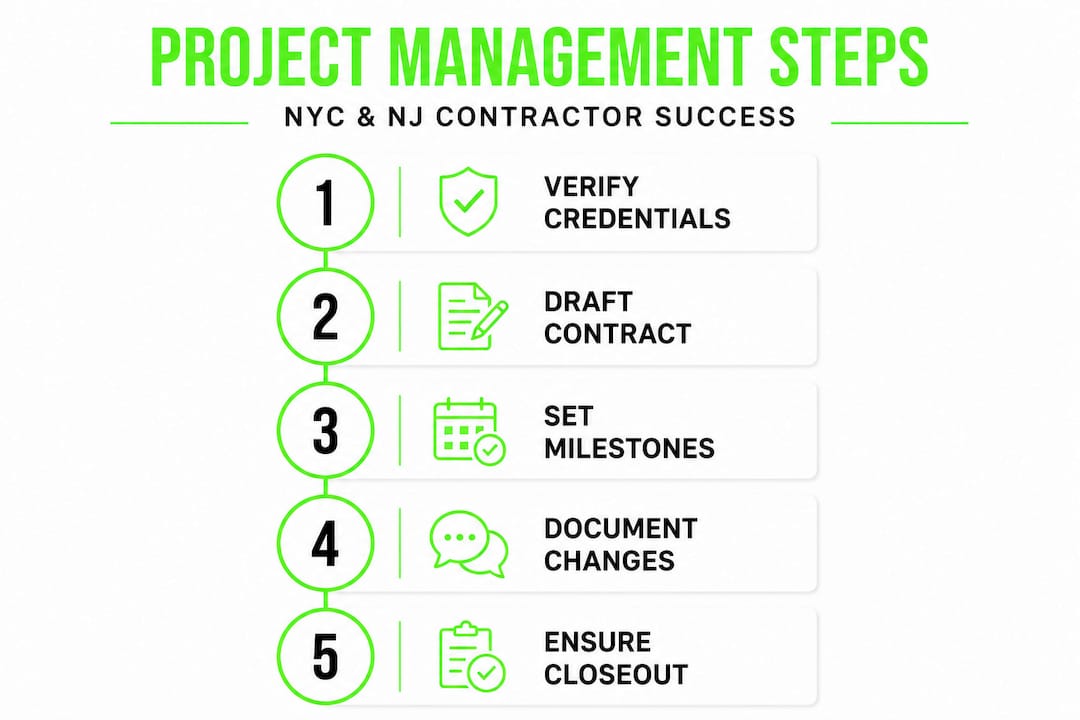
Managing contractor projects in NYC and northern NJ is rarely as straightforward as owners expect. Delays, scope creep, permit violations, and payment disputes are common when clear processes are not in place. Knowing how to manage contractor projects effectively means going beyond hiring a contractor and hoping for the best. It means verifying credentials, writing airtight contracts, tracking milestones, and documenting everything along the way. This guide walks you through each stage, from pre-construction preparation to final closeout, with guidance tailored to the licensing rules and building codes that govern New York City and northern New Jersey.
Table of Contents
Key Takeaways
Point | Details |
Verify licenses and insurance | Always confirm your contractor’s NYC or NJ licenses and insurance certificates before signing any contract. |
Use detailed contracts | A well-defined contract with a precise Statement of Work minimizes disputes and scope creep. |
Track progress with milestones | Set clear project milestones for payments and updates to monitor progress without micromanaging. |
Document everything | Keep dated photos and written communication to protect against payment or scope disputes. |
Plan for change control | Never allow work to start without written approval of change orders to ensure you can approve payments. |
How to manage contractor projects: start with licenses, insurance, and permits
Before any work begins, you need to confirm that your contractor is legally authorized to operate. In NYC and northern NJ, these requirements are specific, and skipping this step puts you at serious legal and financial risk.
NYC requirements:
Contractors must hold an HIC license for any residential improvement project valued over $200. The contract itself must include the license number.
You can verify a contractor’s status through the NYC Department of Consumer and Worker Protection’s online lookup at nyc.gov/dca.
Contractors working on buildings must also be registered with the NYC Department of Buildings (DOB) for permit purposes.
New Jersey requirements:
NJ home improvement contractors must register with the New Jersey Division of Consumer Affairs.
They must carry commercial general liability insurance with a minimum of $500,000 per occurrence and maintain a compliance bond.
Workers’ compensation insurance is required unless specifically exempted.
Permits:
DOB permits in New York City are required for structural work, plumbing, electrical, HVAC, demolition, and facade changes, among other scopes. Cosmetic-only work is often exempt, but when in doubt, confirm with the DOB or your contractor. Permit responsibility typically falls on the contractor, but the owner shares legal exposure if unpermitted work is discovered.
Requirement | NYC | Northern NJ |
Contractor license | HIC license (DCWP) | Home Improvement Contractor registration |
Liability insurance | Required | Minimum $500,000 |
Workers’ comp | Required | Required (with exemptions) |
Permit authority | NYC DOB | Local municipality |
Bond required | No | Yes |
If you are navigating a larger residential project, reviewing the residential additions permit workflow and the home addition checklist for NYC can save you significant time.
Pro Tip: Always request a current certificate of insurance (COI) directly from the contractor’s insurance carrier, not just a copy from the contractor. Call the carrier to confirm it is active before signing anything.
Now that you understand the legal requirements, let’s prepare for managing the project effectively.
Prepare a detailed contract and statement of work (SOW)
A signed contract is not enough protection on its own. What matters most is the quality of what is written inside it. A poorly written contract, or one missing a Statement of Work (SOW), is often where projects begin to fall apart.
A Statement of Work (SOW) is a document that defines exactly what the contractor will deliver, what they will not deliver, and the conditions for accepting completed work. A structured SOW that explicitly lists in-scope and out-of-scope work, along with a formal change process, prevents the majority of scope creep issues before they start.
Your contract and SOW should include:
Contractor’s HIC license number (mandatory in NYC)
Full description of work with material specifications
A list of exclusions, meaning work the contractor will not perform
Acceptance criteria for each phase of work
Payment schedule tied to milestone completion, not calendar dates
A written change order process requiring your signature before any additional work begins
Dispute resolution terms
One of the most cited reasons that payment claims fail in disputes is poor documentation around change orders. When a contractor says “you agreed to that verbally,” you need a written record to prove otherwise.
Contract element | Why it matters |
SOW with exclusions | Prevents unauthorized work and overcharging |
Change order process | Controls scope and cost growth |
Milestone-based payments | Reduces risk of paying for incomplete work |
Acceptance criteria | Gives you a clear basis for approving work |
License number (NYC) | Legally required and confirms legitimacy |
Understanding the benefits of hiring a general contractor can also clarify why a licensed GC handles much of this documentation on your behalf, reducing your administrative burden considerably.
Pro Tip: Never allow work to start on any change without a signed change order in hand. Even one verbal approval sets a precedent that can cost you thousands when disputes arise.
With a solid contract and scope in place, it’s time to track and communicate progress during construction.
Track project progress with milestones and clear communication
One of the most effective contractor project management strategies is milestone-based tracking. Rather than checking in daily or trying to monitor every task, you align your oversight and your payments to measurable progress points.

Milestone-based tracking with regular check-ins at key project percentages helps owners catch issues early without micromanaging the contractor’s daily workflow.
A practical milestone framework:
Pre-construction milestone: All permits pulled, materials ordered, site prepared. First payment released.
25% milestone: Foundation, framing, or rough structural work complete. Review and approve before proceeding.
50% milestone: Rough-in mechanical work, plumbing, and electrical complete and inspected. Second payment released.
75% milestone: Drywall, flooring, or exterior cladding complete. Third payment released.
Final milestone: Punch list completed, final inspection passed, all documentation delivered. Final payment released.
Effective contractor communication during construction:
Schedule a brief walkthrough at each milestone. Keep it focused on comparing actual progress to the SOW.
Use written communication (email or a project app) for any decisions or approvals, not text messages or phone calls alone.
Flag concerns in writing immediately. Do not wait for the next milestone meeting to raise an issue.
Avoid the trap of daily micromanagement. It often damages the working relationship and slows the contractor down. Stick to milestone checkpoints as your primary oversight tool. The interior remodeling workflow guide for NY and NJ provides a useful reference for understanding typical phase sequences.
Pro Tip: Create a simple shared folder (Google Drive works fine) where the contractor uploads daily or weekly progress photos. This creates a passive documentation trail without requiring constant on-site presence.
Having tracked progress effectively, you need to document everything carefully to protect your interests.
Document everything to avoid disputes and protect payments
Documentation is not a backup plan. It is an active risk management tool that you build throughout the project, not after something goes wrong.
Project disputes depend heavily on written proof. When change orders are undocumented, claims fail. When photos do not exist, it becomes your word against the contractor’s. And in a city like New York, where construction litigation is common, gaps in your records are costly.
What to document throughout your project:
Dated photos of concealed work: Take photos before walls close. Plumbing, electrical wiring, insulation, and framing all need to be photographed before they become invisible.
Written change order approvals: Every single one, no matter how small.
Payment records: Keep copies of checks, wire transfer confirmations, and receipts. Never pay in cash without a detailed written receipt.
All email and written communications: Archive them in a single folder organized by date.
Copies of permits and inspection records: These belong to you as the owner and protect you if questions arise after the project closes.
A contractor dispute resolution framework should also be established early. This means agreeing in writing on how conflicts will be raised, reviewed, and resolved before work begins, not mid-project when emotions are already running high.
Pro Tip: At the start of the project, create a physical or digital project binder. Organize it with labeled tabs: Contract, Permits, Change Orders, Payments, Photos, Communications. Doing this from day one takes about 20 minutes and can save you many hours if a dispute arises.
For insight into how the bidding and award process works before you even reach construction, the construction bidding process guide explains what to look for and what questions to ask upfront.
Avoid common mistakes and ensure successful project closeout
Even owners who start well can stumble in the final stretch. Project closeout is where loose ends become expensive if not addressed properly.
Common mistakes to avoid:
Allowing unapproved work to start: Any scope addition without a signed change order creates payment exposure and scope disputes. Treating scope changes without written authorization is a leading cause of payment disputes in NYC construction.
Releasing final payment too early: Withhold the final payment until the punch list is fully resolved, inspections are passed, and all project documentation is delivered to you.
Failing to verify licenses remain active: Contractor licenses and insurance policies can lapse mid-project. Do a quick re-verification at the 50% milestone.
Skipping the final walkthrough: Always conduct a formal final walkthrough with your SOW in hand. Go line by line. If something is missing or incorrect, note it in writing before releasing any payment.
Your project closeout checklist:
Final inspection passed and certificate of occupancy or completion issued (if applicable)
All punch list items signed off in writing
Copies of all permits, inspection sign-offs, and warranties received
Lien waiver signed by contractor and any major subcontractors
Final payment released only after all of the above are confirmed
Milestone-based payments are your most powerful tool for keeping the contractor on schedule through closeout. A contractor who knows final payment depends on a fully completed punch list has a clear incentive to finish the job properly.
For guidance on choosing the right contractor from the start, the Manhattan contractor selection tips article covers key criteria worth reviewing before you sign.
Why most contractor management advice misses the mark (and what really works)
Most articles about managing contractors focus heavily on relationships. “Find someone you trust.” “Communicate openly.” “Build rapport.” That advice is not wrong, but it is dangerously incomplete.
Trust matters. Rapport helps. But what actually protects you when a project runs over budget, a subcontractor files a lien, or work gets done without a permit, is structured process. Operational success in contractor management comes from orderliness: structured records, defined schedules, monitoring systems, and proactive risk mitigation, not just a good working relationship.
Here is what that looks like in practice. A homeowner in Brooklyn who gets along great with their contractor, but never requested a written change order, ends up paying $18,000 more than the original contract because “they agreed” to additions verbally. The contractor remembers it differently. Without documentation, there is no way to resolve that dispute cleanly.
The owners who finish projects on time, on budget, and without litigation are not necessarily the ones with the warmest contractor relationships. They are the ones who treated the project like a business transaction from day one. They followed a structured bidding and contract process, tracked milestones, documented decisions, and used payment timing as leverage.
The shift from reactive to proactive management is simple in theory: stop waiting for problems to surface and build systems that surface them early. Milestone check-ins, document governance, and a written change order process are not bureaucratic overhead. They are the difference between a finished project and a legal dispute.
Get expert help managing your NYC & NJ contractor projects
Managing a renovation or maintenance project on your own is possible, but it requires time, knowledge of local regulations, and consistent follow-through. For many homeowners and business owners in NYC and northern NJ, the risk of costly errors outweighs the appeal of going it alone.

DJ Custom Contracting LLC has been delivering licensed, insured, and code-compliant renovation and maintenance services since 2018. From interior renovations to full commercial projects, the team handles every phase of your project, from permit applications and DOB compliance to final inspections and closeout. Whether you need a general contractor to oversee your full project, a specialist for interior renovation work, or an experienced team for commercial renovation projects, DJ Custom Contracting brings the process, documentation, and trade knowledge to get it done right. No job is too big or too small.
Frequently asked questions
How can I verify if a contractor has a valid NYC Home Improvement Contractor license?
You can use the NYC Department of Consumer and Worker Protection’s online Business License Lookup tool at nyc.gov/dca to check a contractor’s license status. The HIC license lookup lets you search by business name or license number before signing any contract.
What insurance should New Jersey home improvement contractors have?
NJ contractors must carry commercial general liability insurance of at least $500,000 per occurrence along with workers’ compensation insurance, unless specifically exempted by law. Always request a current certificate of insurance directly from the carrier.
When are permits required for home renovations in NYC?
DOB permits are required for structural, electrical, plumbing, HVAC, facade, and demolition work, as well as changes of use. Cosmetic-only projects like painting or flooring replacement typically do not require permits, but confirm the scope with your contractor or the DOB before assuming.
Why is a detailed statement of work important when managing contractor projects?
A clear SOW defines what is included and excluded from the project, which prevents scope creep and gives you a written basis for resolving disputes. A structured SOW with a formal change order process prevents most overwork and billing conflicts before they start.
Recommended


Comments