


Residential vs. Commercial Construction: Key Differences

Most property owners assume the gap between residential and commercial construction comes down to size. A house is small; a retail building is big. That framing misses a far more consequential reality. The moment your project crosses certain thresholds in occupancy type, unit count, building height, or intended use, it can shift from a straightforward residential permit to a full commercial code pathway, and that shift changes almost everything: your engineer requirements, fire protection obligations, inspection schedule, timeline, and total project cost. For owners and developers in Northern New Jersey and New York City, understanding these code paths early is not a bureaucratic formality. It is one of the most important decisions you will make before a single drawing is produced.
Table of Contents
Key Takeaways
Point | Details |
Legal definitions drive process | Project classification as residential or commercial determines code, permitting, and compliance steps from start to finish. |
Permit mistakes are costly | Missteps can result in major fines or forced redesign, especially in NYC and NJ. |
Commercial projects require more layers | Expect greater engineering, life-safety requirements, and a more complex approval workflow. |
2026 costs are rising | Bid prices are escalating for all construction; correct classification and planning help minimize surprises. |
Expert advice prevents project pain | Engage professionals early to identify your code pathway and avoid expensive rework or violations. |
How code and definitions shape your project
Understanding the rules means first understanding how your project is defined by code.
In New Jersey, all construction is governed at the state level. The NJ Uniform Construction Code (UCC), codified as N.J.A.C. 5:23, sets the framework for how every project is permitted, inspected, and closed out. The UCC does not leave classification to guesswork. It maps each project type to a specific set of technical subcodes, and your classification determines which reviewers see your plans, which inspections are required, and how long the process takes.
At the national level, two model codes do most of the heavy lifting. The International Residential Code (IRC) applies to one- and two-family dwellings and certain townhouses that stay within defined height and scope limits. The International Building Code (IBC) governs everything else, including most multi-family buildings, mixed-use structures, and all commercial occupancies. The distinction matters because the IBC carries substantially more demanding requirements around fire suppression systems, egress design, structural engineering, and accessibility compliance.
Here is a quick snapshot of how common project types map to each code path in the Northern NJ and NYC region:
Project type | Primary code authority | Permitting body | Key added requirements |
Single-family home (NJ) | IRC / NJ UCC residential subcode | Local construction office | Standard plan review |
Two-family or townhouse (NJ) | IRC (within limits) | Local construction office | May require fire separation review |
Three-unit or larger multi-family | IBC / NJ UCC building subcode | Local or county authority | Fire protection, egress, accessibility |
Commercial retail or office fit-out | IBC | NYC DOB or local NJ office | RA or PE filing, life-safety review |
Mixed-use (residential over commercial) | IBC (typically) | NYC DOB or local authority | Dual occupancy analysis required |
The triggers that push a project from the IRC track to the IBC track are worth knowing in advance. They include:
Building height exceeding three stories or 35 feet
More than two dwelling units on one structure
Any occupancy that mixes residential with retail, office, or other commercial use
Accessory structures or additions that change the primary occupancy classification
Change of use from residential to commercial, even in a partial conversion
When you are planning building additions, these triggers are the exact points where early consultation with a contractor or design professional prevents expensive surprises later. Missing them during scoping is one of the most common and costly mistakes property owners make.
Regulatory complexity: What to expect for each type
Once you know how your project is classified, the next layer is understanding how much process and paperwork that sets in motion.
Residential projects governed by the IRC are relatively prescriptive. That means the code provides specific, standardized solutions that most contractors and reviewers know well. A typical single-family renovation in NJ follows a fairly predictable path: you submit plans to the local construction code office, a reviewer checks compliance with the building, electrical, plumbing, and mechanical subcodes, and inspections are scheduled at rough and final stages.
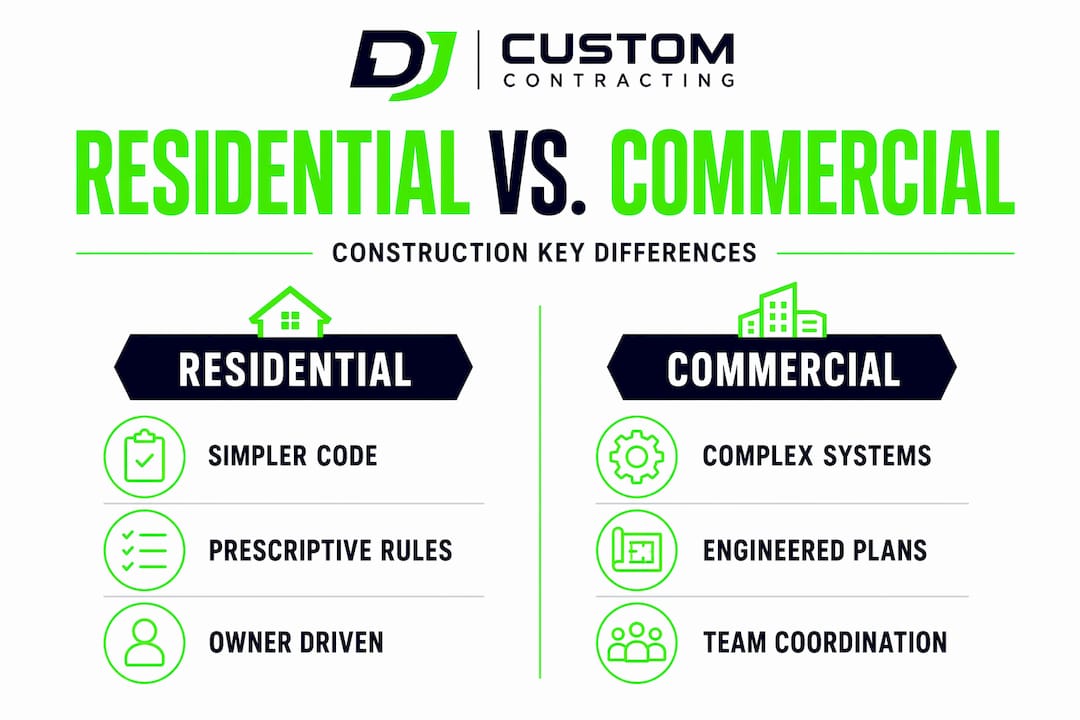
Commercial projects operate differently. The NJ UCC technical subcodes include building, electrical, fire protection, plumbing, and additional specialized subcodes, and a commercial project often triggers several of them simultaneously. That means multiple reviewers, multiple inspection tracks, and coordination between design disciplines that a straightforward residential job simply does not require.
Commercial construction typically requires more complex, engineered life-safety and building systems coordination, including fire suppression, accessibility and egress design, and HVAC systems. These are not optional upgrades. They are code-mandated requirements that apply regardless of project budget or owner preference.
Here is a direct comparison of how the regulatory process plays out:
Factor | Residential (IRC path) | Commercial (IBC path) |
Plans required | Basic architectural drawings | Engineered drawings across multiple disciplines |
Reviewers involved | One to two subcode reviewers | Multiple subcode reviewers, often including fire official |
Inspections | Rough and final (standard stages) | Multiple milestone inspections, life-safety sign-off |
Typical approval timeline | Two to six weeks | Six weeks to several months |
Estimated soft cost uplift | Low | Moderate to high |
A typical approval path for a residential project in NJ or NYC looks like this:
Engage a designer or architect for drawings
Submit plans and application to local construction office or NYC DOB
Plans review for code compliance (building and applicable subcodes)
Permit issued after approval
Inspections at framing, rough mechanical, and final stages
Certificate of occupancy or approval issued
For a commercial project, the process expands considerably:
Engage a Registered Architect (RA) or Professional Engineer (PE) for full construction documents
Complete multi-discipline drawings (structural, mechanical, electrical, plumbing, fire protection)
Submit to applicable authority (NYC DOB or NJ local office) for full plan review
Respond to plan examiner comments and resubmit as needed
Permit issued after all subcode approvals are obtained
Multiple field inspections at defined construction milestones
Fire official sign-off on life-safety systems where required
Final certificate of occupancy issued
Following the interior remodeling workflow guide for NJ and NYC projects gives you a clearer picture of where each step fits in the larger construction timeline.
Pro Tip: Always contact your local construction code office before finalizing your project scope. Ask specifically which subcodes apply to your project type and whether any specialty engineer sign-off is required. A 20-minute phone call at the planning stage can prevent weeks of rework after submission.
Permit, inspections, and enforcement in NYC and NJ
Regulatory requirements get enforced through the permitting and inspection pipeline. Here is what you must get right to avoid extra costs and delays.
In New York City, the Department of Buildings (DOB) administers construction permits and enforcement. Many construction activities in NYC require a DOB permit, and work performed without the proper permit can trigger Work Without Permit (WWP) violations along with Stop Work Orders and substantial fines. This is not a risk worth taking. Violations follow a property, not just a project, which means they surface during future sales, refinancing, or lease negotiations.
Fines for unpermitted construction in NYC can exceed $25,000 per violation, and Stop Work Orders can shut down an active job site until all compliance issues are resolved. For commercial projects, enforcement actions can also trigger mandatory third-party inspections at the owner’s expense.
The plan review and filing process in NYC reinforces the residential versus commercial divide. NYC permit workflows for major scopes commonly require submission by a Registered Architect or Professional Engineer. For residential alterations that are relatively minor, a contractor may self-certify some aspects. For most commercial alterations or any project that involves structural work, a change of occupancy, or new mechanical systems, RA or PE involvement is required and not optional.
Common permit and inspection problems to watch for in both sectors include:
Submitting under the wrong job type (residential versus alteration type in NYC), which can require full resubmission
Failing to list all subcode work in the initial application, triggering supplemental permits
Scheduling inspections before required preceding inspections are complete and signed off
Not obtaining sign-off from the fire sub-code inspector when fire protection work is included
Missing required Special Inspection reports for structural, soil, or concrete work on IBC-path projects
If a prior owner left unresolved building code violations on your property, those must typically be cleared before a new permit is issued or a certificate of occupancy is granted.
The home addition checklist developed specifically for NYC owners covers many of these permitting steps in a format you can apply directly to your own project planning.
Cost, coordination, and market trends for 2026
How do these rules and requirements translate to real dollars, and what trends should you expect for project cost and complexity in 2026?
The short answer is that construction costs remain elevated, and the regulatory complexity layered on top of a commercial project adds meaningful soft costs on top of hard construction expenses. Bid-price escalation for 2026 is projected at approximately 4.25% nationally, affecting both residential private and nonresidential private construction categories.
That 4.25% figure matters more for commercial projects because the base costs are already higher. A mid-size commercial renovation in NJ or NYC carries engineering fees, multiple permit fees, extended review timelines, and specialty inspection costs that a comparable residential job does not. When bid prices rise across the board, those multipliers make the gap even wider.
The primary drivers of cost difference between residential and commercial projects include:
Engineering fees: Commercial projects require PE and RA involvement across multiple disciplines; residential work often does not
Permit and review fees: Commercial permit fees are typically calculated on construction value and can be substantially higher than residential equivalents
Material specifications: IBC-governed projects often require rated assemblies, fire-resistant materials, and commercial-grade mechanical and electrical systems
Extended schedule risk: Longer plan review timelines mean more time for material prices to shift before a project breaks ground
Inspection costs: Multiple specialty inspections and third-party oversight add line items that residential owners rarely encounter
Contingency requirements: Code path uncertainty, particularly on edge-case or conversion projects, increases the likelihood of change orders
Incorrect project classification compounds all of these costs. If a project is initially scoped and priced as residential but is later found to require IBC compliance, the redesign, re-engineering, and re-submission process can add months to the schedule and tens of thousands of dollars in unplanned costs.
Pro Tip: Build a minimum 15% contingency into your budget for any project that involves a change of use, a conversion, or a building that sits near the thresholds for IRC versus IBC classification. The cost of carrying that contingency is always less than the cost of a mid-project code path correction.
Planning around facility maintenance essentials for commercial properties also helps owners anticipate ongoing compliance costs beyond the initial construction phase.
Our take: The biggest pitfalls and overlooked opportunities
Now that you know how the systems work, here is what actually creates headaches in practice, and where smart owners find real advantages.
The most consistent problem we see is owners and even some designers locking in a project scope and budget before confirming the code pathway. It sounds basic, but the pressure to move quickly pushes people to start drawing before asking the fundamental question: does this project fall under the IRC or the IBC? We have seen live-work conversions, garage-to-accessory dwelling unit projects, and small retail-to-residential flips all misclassified at the design stage. Once plans are drawn, reviewed by the owner, and priced by multiple contractors, discovering a code path error means everyone starts over.
Edge-case projects are the highest-risk category. Mixed-use buildings, warehouse-to-residential conversions, and any project involving a change of occupancy class require upfront occupancy analysis before any design work begins. The IRC versus IBC code path distinction is especially sharp for these projects because the design implications are not minor adjustments. They involve different structural systems, completely different egress configurations, and fire protection requirements that cannot be retrofitted cheaply.
The flip side of this risk is a genuine opportunity. When owners get the code pathway confirmed at the very start of the scope stage, the entire project runs smoother. Permitting timelines become predictable. Contractor bids are apples-to-apples because every bidder is pricing the same scope of work. Change orders related to code compliance drop sharply. We have seen commercial renovation projects in Northern NJ come in on time and under budget simply because the owner invested in a pre-design code consultation and knew exactly what they were committing to.
The benefits of hiring a general contractor who works across both residential and commercial sectors are especially clear here. An experienced GC has seen both code paths applied to similar building types and can flag the edge cases before they become expensive problems.
Pro Tip: Bring in an experienced contractor or design professional at the scope stage, not after you have already invested in a full set of drawings. A brief pre-design consultation can save more money than any other single decision you make on a project.
How we help with both residential and commercial projects
At DJ Custom Contracting LLC, we work across both residential and commercial construction every day. Our team understands the code pathways, the permitting processes, and the practical differences in how each project type is executed in Northern New Jersey and New York City.

Whether you are planning an interior renovation for your home, updating your property’s exterior systems, or moving forward with a commercial renovation, we bring the same level of attention to compliance and quality to every project. We handle DOB and DOT violation removal, additions, alterations, and damage restoration for clients across the region. No job is too large or too small, and we are with you from initial scope through final sign-off.
Frequently asked questions
What is the main difference between residential and commercial construction in NJ and NYC?
Residential projects follow the IRC with simpler permitting and more prescriptive standards, while commercial projects must meet IBC requirements that involve engineered life-safety systems, more complex plan review, and greater regulatory oversight.
Can a building project change from residential to commercial classification?
Yes; expanding occupancy, adding business uses, or exceeding IRC scope limits can trigger the commercial IBC code path, which may require a complete redesign of the structural, egress, and fire protection systems.
What are the penalties for construction without a permit in NYC?
Fines for unpermitted work can exceed $25,000 per violation, and the DOB can issue Stop Work Orders that halt your project until all compliance issues are corrected.
Who prepares and files construction plans for commercial projects in NYC?
Most major commercial submissions require plans prepared and filed by a NY State Registered Architect or PE, and self-certification options are limited for complex or higher-risk project types.
Are commercial construction costs rising in 2026?
Yes, national bid-price escalation is projected at approximately 4.25% for 2026, affecting both residential and nonresidential construction sectors and adding pressure to budgets across all project types.
Recommended


Comments