


What is commercial contracting? A guide for NY & NJ owners


If you manage a commercial property or run a business in New York or New Jersey, understanding what is commercial contracting is not optional. It directly affects whether your renovation gets done legally, on time, and within budget. Many owners assume the process mirrors residential work or that rules are uniform across the region. They are not. Commercial contracting involves distinct legal requirements, licensing structures, and project delivery models that vary by municipality, project type, and scope. Getting clear on the fundamentals before you sign anything is one of the most valuable things you can do for your project.
Table of Contents
Understanding commercial contracting: definitions and core concepts
Licensing and regulatory requirements for commercial contractors in New York and New Jersey
Comparing general contracting with other commercial delivery models
The role of the commercial contractor throughout your project lifecycle
Rethinking commercial contracting: what most owners miss and how to avoid pitfalls
How DJ Custom Contracting supports your NY & NJ commercial projects
Key Takeaways
Point | Details |
Commercial contracting scope | Commercial contracting manages non-residential building projects through formal agreements involving licensed contractors and subcontractors. |
Written contracts matter | Clear, written commercial contracts define obligations and remedies, which reduce disputes and protect all parties. |
Licensing varies by location | NY requires local contractor licenses with no statewide license; NJ has state and municipal layers affecting commercial contractor registration. |
Delivery model differences | General contracting, construction management, and design-build differ in risk allocation, coordination roles, and suitability for project types. |
Project lifecycle role | General contractors coordinate trades, manage compliance, schedules, payments, and closeout, serving as the owner’s main point of contact. |
Understanding commercial contracting: definitions and core concepts
Commercial contracting refers to the organized process of planning, managing, and executing construction or renovation work on commercial properties. This includes office buildings, retail spaces, restaurants, warehouses, medical facilities, and mixed-use properties. Unlike residential projects, commercial work operates under stricter building codes, more complex permitting requirements, and tighter insurance and liability standards.
At the center of most commercial projects sits the general contractor (GC). The GC is the licensed professional responsible for coordinating the entire project on behalf of the owner. They hire and manage subcontractors (plumbers, electricians, carpenters), source materials, obtain permits, and maintain the construction schedule from start to finish. As a commercial renovations guide for NY and NJ owners highlights, this full-scope coordination is what separates commercial general contracting from smaller, more fragmented project approaches.
According to the general contracting overview, commercial general contracting covers full project management through construction and closeout, acting as the owner’s single accountability point. That single point of accountability matters enormously when multiple trades, inspections, and deadlines are running simultaneously.
A commercial project typically moves through four core phases managed by the GC:
Pre-construction: Site assessment, budgeting, design coordination, and scheduling
Permitting: Submitting and tracking all required permits with the local Department of Buildings
Execution: Overseeing daily construction activity, subcontractor performance, and quality control
Closeout: Final inspections, punch lists, warranty documentation, and turnover to the owner
With a clear definition of commercial contracting established, let’s examine the legal framework that governs these agreements.
Legal framework and contracts in commercial contracting
A commercial contract is a legally binding written agreement between the property owner and the contractor. It defines what work will be done, when it will be completed, how payments will be structured, and what happens when something goes wrong. Without a written contract, disputes become difficult and expensive to resolve.
Commercial contracts are typically written to define parties’ obligations and remedies, reducing ambiguity and legal disputes. This is especially true for renovation projects where scope changes are common and costs can escalate unexpectedly.
A well-structured commercial contract should include:
Scope of work: A precise description of every task to be performed, including materials and finishes
Timeline and milestones: Start date, completion date, and key interim deadlines
Payment schedule: Deposit amounts, progress payments tied to milestones, and final payment terms
Change order procedures: A formal process for authorizing and pricing any work beyond the original scope
Remedies for non-performance: What happens if the contractor misses deadlines or the owner withholds payment
As noted in the hiring a general contractor benefits resource, a written contract is not just legal protection. It is a project management tool that keeps both parties aligned throughout the job.
Understanding the legal backbone of commercial contracts helps us examine specific licensing and regulatory requirements in NY and NJ.
Licensing and regulatory requirements for commercial contractors in New York and New Jersey
Licensing is where many business owners and property managers get caught off guard. The rules are genuinely complex, and they differ between states and even between municipalities within the same state.

In New York, there is no statewide general contractor license. Instead, licensing is local, meaning each jurisdiction sets its own requirements. New York City, for example, requires contractors to hold a NYC Department of Buildings license for specific trades such as plumbing and electrical. General contractors performing certain work in NYC must also register with the DOB and maintain adequate insurance. Working without the correct local license can result in stop-work orders, fines, and voided permits.
New Jersey operates differently but is equally nuanced. The state’s Home Improvement Contractor registration applies mainly to residential work. Some NJ municipalities require commercial contractor licensing, but state registration mainly applies to home improvement contractors, making local verification essential before hiring anyone. This means a contractor who is fully registered at the state level in NJ may still need separate municipal approval to legally perform commercial work in your town.
Key documents and credentials to verify before engaging a commercial contractor in NY or NJ include:
Local jurisdiction license or registration (confirm with the relevant city or county office)
General liability insurance (minimum coverage levels vary by project and jurisdiction)
Workers’ compensation insurance (required for any contractor employing workers in both states)
NYC DOB license or registration (for projects within the five boroughs)
Trade-specific licenses for electricians, plumbers, and HVAC technicians assigned to the job
Pro Tip: Before signing any contract, ask your contractor to provide their license number and insurance certificates, then verify them directly with the issuing authority. In NYC, the DOB BIS portal allows you to search contractor registrations online in minutes.
You can also review the interior remodeling workflow for a practical overview of how licensed contractors in NY and NJ structure the permitting and approval process for interior work.
Having reviewed licensing, let’s compare the general contracting model with alternative commercial project delivery methods.
Comparing general contracting with other commercial delivery models
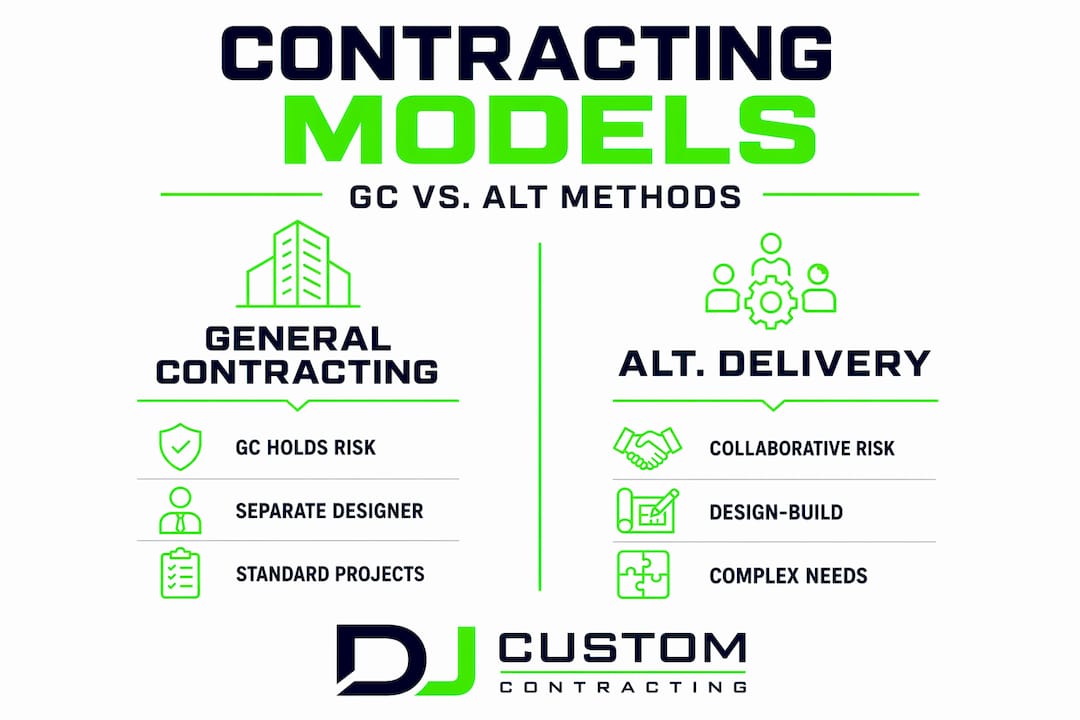
Not every commercial project uses the same delivery structure. Understanding the three primary models helps you choose the right approach for your renovation or construction need.
Delivery model | Who holds risk | Design and construction | Best for |
General contracting | GC assumes contract risk | Separate (owner hires designer) | Standard renovations and fit-outs |
Construction management | Owner retains risk | Separate (CM acts as agent) | Large, complex projects needing owner control |
Design-build | Single entity holds all risk | Combined in one contract | Fast-track projects with flexible design |
The general contracting model assumes risk and holds contract responsibility unlike construction management, which acts as the owner’s agent, and design-build combines design and construction in one contract. Each model affects your cost exposure, timeline, and how much control you retain.
Here is when each model tends to work best:
General contracting: You already have a completed design and want one licensed contractor to manage full execution and assume performance risk. This is the most common model for commercial renovations in NY and NJ.
Construction management: You want more direct control over subcontractor selection and cost transparency on a large or phased project. You accept more financial risk in exchange for oversight.
Design-build: You need speed and can allow the contractor to influence design decisions. Retail buildouts and tenant improvements often use this approach.
Pro Tip: For most renovation and maintenance projects handled by business owners and property managers, the general contracting model offers the clearest risk transfer and accountability. If you are not an experienced developer, taking on the owner’s risk role in a construction management arrangement requires significant in-house expertise to manage well. You can review choosing a general contractor guidance for practical factors to evaluate when selecting a GC.
With a clear understanding of delivery models, you can better navigate your project’s contracting needs by examining the contractor’s role throughout the full lifecycle.
The role of the commercial contractor throughout your project lifecycle
A GC’s responsibilities extend well beyond showing up on a job site. Their value lies in systematic coordination and documentation across every phase of your project. Here is how that unfolds in sequence:
Pre-construction planning: The GC reviews drawings, identifies long-lead materials, develops a project schedule, and submits for permits. In NYC, this can involve coordinating with the Department of Buildings and addressing any prior violations on the property.
Permitting and approvals: The GC manages the permit application process, responds to DOB plan examiner comments, and schedules required inspections throughout the project.
Site mobilization: Setting up safety measures, temporary utilities, and site protection before work begins, particularly important in occupied commercial buildings.
Construction execution: Daily coordination of subcontractors, materials delivery, and site safety. The GC tracks schedule progress and resolves conflicts between trades.
Inspections and compliance: Scheduling required inspections at each phase (rough-in, framing, fire protection, and so on) and ensuring all work passes before proceeding.
Pay applications and change orders: The GC processes monthly or milestone-based payment applications and documents any scope changes through formal change orders signed by both parties.
Project closeout: Final inspections, obtaining a certificate of occupancy where required, delivering warranties from subcontractors, and completing the punch list.
The GC coordinates trade labor, administers inspections, manages schedules, processes pay applications, and documents changes through formal change orders. Each of these functions protects the owner from gaps, delays, and unanticipated costs.
Skipping formal change order documentation is one of the most common reasons commercial renovation costs spiral beyond the original budget. Every scope change, no matter how minor it seems, should be documented in writing before work proceeds.
The benefits of general contractor oversight become most visible during inspections and closeout, when missing documentation can delay occupancy and create expensive problems.
Now that you understand the contractor’s role throughout your project, let’s explore a contrarian perspective on what owners most commonly get wrong.
Rethinking commercial contracting: what most owners miss and how to avoid pitfalls
Here is an uncomfortable truth. Most commercial contracting problems do not start during construction. They start before the first shovel hits the ground, in the gaps between what owners assume and what the contract actually says.
Many business owners and property managers focus heavily on price when selecting a contractor. That is understandable. But the lowest bid often signals that the contractor either missed scope items or plans to recover margin through change orders later. A thorough written scope of work prevents both problems. Clear written contract terms including scope, timelines, termination, and remedies are critical to reduce enforceability problems and risk.
Licensing verification is the other area where owners routinely cut corners. There is a false confidence that comes from receiving a license number from a contractor. Very few owners actually verify that number with the issuing authority, confirm the license covers the specific type of commercial work being performed, or check that insurance certificates are current and name the correct additional insured parties. These details matter in NY and NJ, where local licensing nuances can expose you to liability if something goes wrong with an improperly licensed contractor on your property.
Owners should also carefully evaluate GC responsibilities and alternatives like construction management or design-build as risk and coordination roles can materially change. Choosing the wrong delivery model for your project’s complexity is a costly mistake that plays out over months.
The practical takeaway is this. Hire for transparency, verify credentials independently, and treat the contract as a working document, not a formality. Review it with someone who understands commercial construction law in your jurisdiction. The hiring professionals for protection resource outlines exactly why experienced, licensed professionals reduce your legal and financial exposure across the life of a project.
How DJ Custom Contracting supports your NY & NJ commercial projects
Understanding commercial contracting gives you the tools to make smarter decisions. Putting that knowledge to work requires a contractor who knows the landscape in New York and New Jersey as well as you do.

DJ Custom Contracting LLC has been delivering commercial renovation and general contracting services since 2018, with deep familiarity with local licensing requirements, DOB compliance, and the full project lifecycle from pre-construction through closeout. Whether you need a commercial renovation contractor for a full buildout, a general contractor to manage a phased renovation, or an interior renovation contractor for a specific space, the team is equipped to handle projects of any scale. No job is too big or too small. Contact DJ Custom Contracting today to discuss your commercial project and get a clear, detailed plan for moving forward.
Frequently asked questions
What is the main role of a general contractor in commercial projects?
A general contractor coordinates all trade labor, manages scheduling, ensures compliance with permits and inspections, and serves as the single accountable point to the project owner throughout construction. In a commercial arrangement, the GC serves as a single point of accountability, coordinating trade labor, administering inspections, and maintaining the master schedule.
Why are written contracts important in commercial contracting?
Written commercial contracts clearly define each party’s obligations, timelines, and remedies for non-performance, which reduces ambiguity and helps prevent legal disputes. Commercial contracts define parties’ obligations, timelines, and remedies, helping reduce ambiguity and disputes.
Do contractors need the same licenses to work on commercial projects in NY and NJ?
No, licensing requirements vary widely. New York licenses contractors locally with no statewide general contractor license, while New Jersey’s statewide registration often excludes commercial-only contractors, and municipalities can add their own requirements. Some NJ municipalities have licensing requirements for commercial contractors while statewide registration mainly applies to home improvement contractors.
How can business owners avoid common commercial contracting pitfalls?
Business owners should verify all local licensing requirements, clearly define contract terms including scope and remedies, and understand the distinctions between delivery models to ensure proper risk transfer and project clarity. Owners should clearly define contract terms and verify local licensing to reduce enforcement problems and manage risk, and should also evaluate differences between GC responsibilities and alternatives as these affect risk and coordination.
Recommended


Comments