


The Role of Licensing in Construction: 2026 Guide

Construction licensing is the legal authorization that allows contractors to perform regulated building work, and without it, a project can be voided, a payment claim denied, and a lien thrown out of court. The role of licensing in construction goes far beyond paperwork. It defines who can legally contract, pull permits, bid on jobs, and be held accountable for workmanship. For property owners and industry professionals alike, understanding how licensing works is not optional. It is the foundation of every compliant, enforceable project.
How does the role of licensing in construction affect your project?
Contractor licensing in the U.S. is a state and local regulatory system that controls legal authorization to perform construction work. It determines eligibility for bidding, advertising services, pulling permits, and signing contracts. A contractor without the correct license cannot legally do any of those things.
Licensing boards function as consumer-protection mechanisms that enforce construction quality and restrict who can perform licensed work. This directly impacts public safety. When a licensed contractor builds a structure, the license signals that the individual has passed exams, met insurance requirements, and accepted legal accountability for the work.

One distinction worth knowing early: business licenses and contractor licenses are separate. A business license permits a company to operate within a jurisdiction. A contractor license authorizes that company to perform regulated construction work. Most contractors need both to operate legally, and confusing the two is a common compliance mistake.
Do construction licensing requirements vary by state?
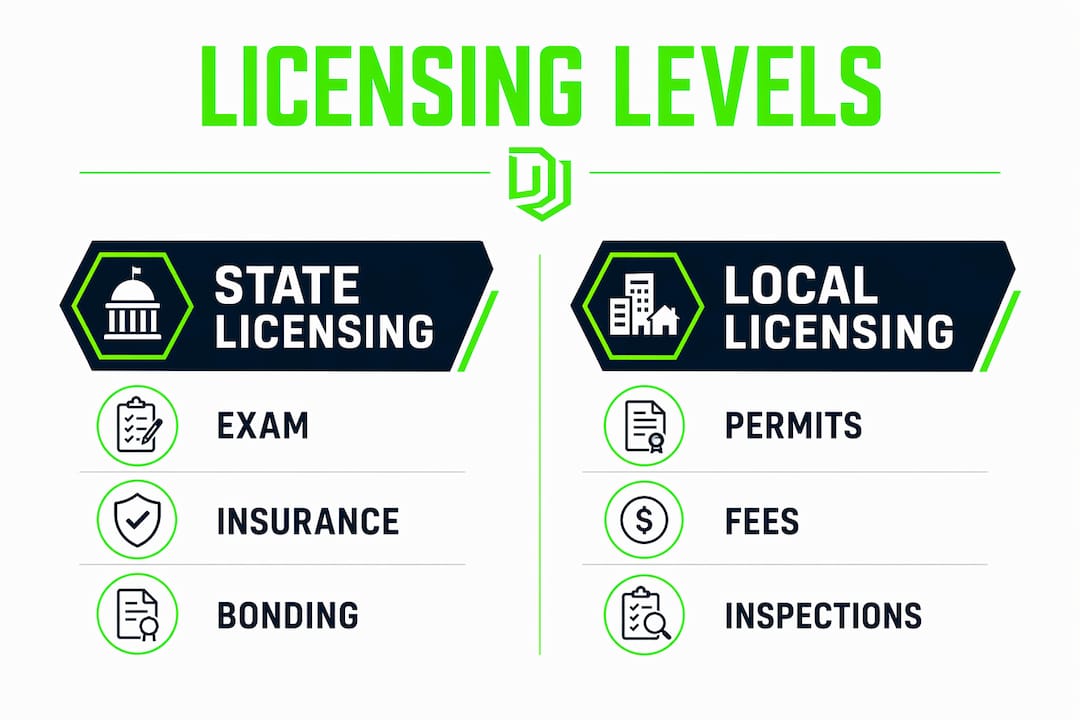
Yes, and the variation is significant. 29 U.S. states mandate state-level contractor licenses, while the remaining 21 states delegate licensing to cities and counties or have no statewide requirement at all. That means a contractor licensed in one state may be completely unauthorized to work in another, even on an identical project type.
The table below shows how licensing structures differ across representative states:
State | Licensing Level | Key Requirements |
Florida | State | Exam, insurance, bonding, CE hours |
New York | Mostly local (NYC, counties) | City-specific registration and insurance |
California | State (CSLB) | Exam, bond, workers’ comp |
Texas | Mostly local | City permits and local registration |
Georgia | State | Exam, financial statement, insurance |
Beyond the state vs. local divide, requirements also differ in scope, fees, exam formats, insurance minimums, and bonding amounts. A general contractor license in Florida covers a broad range of work. A specialty license in California may restrict a contractor to electrical, plumbing, or HVAC work only. Contractor license classifications must align precisely with the actual work being performed. Performing work outside your license classification can void the license’s legal protection entirely.
For property owners, this creates a clear obligation: verify that your contractor holds the correct license type for your specific project location, not just a license in general.
Pro Tip: Ask your contractor to provide their license number and then verify it directly through your state or city licensing board’s online portal before signing any contract.
Key factors that vary by jurisdiction include:
Exam requirements: Some states require trade-specific exams; others require business and law exams in addition.
Insurance and bonding: Minimum coverage amounts differ widely between states and project types.
Fees: Application and renewal fees range from under $100 to several hundred dollars depending on the state.
Reciprocity agreements: Some states honor licenses from other states; most do not.
How does licensing affect payment rights and lien claims?
This is where the importance of construction permits and proper licensing becomes a financial issue, not just a regulatory one. A valid contractor license is often required to enforce payment claims. An unlicensed contractor who completes work and then tries to collect payment may find that courts will not enforce the contract at all.
The consequences follow a clear sequence:
Contract execution without a license: The contract may be deemed unenforceable from the start, leaving the contractor with no legal basis to demand payment.
Completed work, no license: Courts in many states will not award compensation even when the work was performed and accepted by the owner.
Mechanic’s lien filing: Unlicensed contractors usually cannot file valid mechanic’s liens. Courts routinely dismiss liens filed without proper licensure unless narrow exceptions apply.
Post-contract cure: Some states disallow remedying a lack of licensure after contract execution. Getting licensed after the fact does not fix the problem retroactively.
Mechanic’s lien validity depends on licensing compliance during the actual performance of the work. Courts focus on whether the contractor was licensed when the work was done, not when the lien was filed. This is a critical detail for both contractors and property owners managing contractor projects in NYC and NJ.
Pre-contract due diligence on licensing and qualifier status is the single most effective way to avoid losing payment remedies later. Verify before you sign, not after a dispute arises.
For property owners, the flip side matters too. Hiring an unlicensed contractor can expose you to liability for injuries on the job site, code violations, and the cost of correcting substandard work with no legal recourse. Knowing what to do when a contractor dispute arises starts with having a licensed contractor in the first place.
What is a qualifying agent and why does it matter?
A qualifying agent is the licensed individual whose personal credentials give a construction company its legal authority to operate. The qualifying agent’s personal license provides the company’s legal authority to pull permits, bid on work, and sign contracts. Without an active qualifier, the company has no legal standing to perform licensed construction work, regardless of its corporate structure.
This arrangement has direct consequences for both contractors and property owners:
If the qualifier’s license expires or is suspended, the company’s license status is immediately affected.
The qualifier is legally accountable for building code compliance and licensing violations on every project the company undertakes.
A qualifier’s license suspension can halt all company operations, even if the company holds a separate corporate entity.
One serious risk in this area is “license renting.” This occurs when a company uses a licensed individual’s credentials without that person providing genuine active oversight. License renting is illegal and risks serious sanctions, including license revocation and criminal penalties in some states. It is more common than most property owners realize, and it leaves projects legally exposed.
For property owners, verifying the qualifier’s status is as important as checking the company’s license. Ask for the qualifier’s name, their individual license number, and confirm both are active through the relevant licensing board. Review the key questions to ask your contractor before any project begins.
How do licensing renewals and continuing education affect compliance?
A license obtained today does not remain valid indefinitely. Contractor licenses require regular renewal and continuing education, with specific CE hours and fees that vary by state. In Florida, for example, licensed contractors must complete 14 DBPR-approved continuing education hours every two years, covering topics like wind mitigation, workers’ compensation, and business practices. That requirement reflects how licensing keeps contractors current with evolving building codes and safety standards.
Letting a license lapse creates immediate problems. A contractor with an expired license faces the same legal exposure as an unlicensed contractor. Payment claims become unenforceable. Permits cannot be pulled. Active projects may need to stop until the license is reinstated.
Best practices for staying compliant include:
Track renewal dates: Set calendar reminders at least 90 days before expiration to allow time for CE completion and paperwork.
Confirm CE provider approval: Not all continuing education courses qualify. Verify that your provider is approved by the relevant state board before enrolling.
Monitor qualifier status: If your company relies on a qualifying agent, confirm their renewal status independently, not just your company’s license status.
Keep insurance current: Many states tie license renewal to proof of active general liability and workers’ compensation insurance. A lapsed policy can trigger a license suspension.
Understanding contractor insurance requirements in NY and NJ is part of the same compliance picture. Insurance and licensing are linked at renewal, and both must stay current for a project to proceed legally.
Key takeaways
Construction licensing legally authorizes contractors to perform regulated work, and its absence voids contracts, blocks payment claims, and disqualifies mechanic’s liens.
Point | Details |
Licensing grants legal authority | Without the correct license, a contractor cannot legally bid, permit, or contract for regulated work. |
State and local rules differ | 29 states require state-level licenses; others delegate to cities and counties, requiring location-specific verification. |
Unlicensed work voids payment rights | Courts routinely dismiss payment claims and mechanic’s liens filed by unlicensed contractors. |
Qualifying agents bind company status | If a qualifier’s license expires or is suspended, the entire company’s operating authority is affected. |
Renewals require active management | Expired licenses carry the same legal risks as no license; track CE deadlines and insurance renewals together. |
What i’ve learned about licensing after years in the field
The biggest mistake I see property owners make is treating license verification as a formality. They ask “are you licensed?” and accept “yes” as a complete answer. That is not enough. You need the license number, the qualifier’s name, the license classification, and you need to verify all of it through the state or city board before the contract is signed.
On the contractor side, the most common pitfall is assuming that a license in one jurisdiction covers work in another. I have seen contractors lose payment disputes because they performed work under a license that did not cover the specific trade or location. The license classification must match the actual scope of work, not just the general category.
Licensing is also a competitive advantage that many contractors underuse. A fully licensed, bonded, and insured contractor with an active qualifier and current CE hours is a fundamentally lower-risk choice for any property owner. That credibility translates directly into winning bids and building long-term client relationships.
For property owners, the pre-contract checklist is simple: verify the license, verify the qualifier, confirm the classification covers your project type, and check that insurance is current. Doing this before signing takes 20 minutes. Not doing it can cost you the entire project budget with no legal recourse.
— DJ
Work with a fully licensed contractor you can trust

Djcustomcontracting has operated since 2018 with full compliance across residential and commercial projects in New York and New Jersey. Every project is performed under active licensing, proper insurance, and adherence to local building codes. Whether you need interior renovations, exterior work, additions, or DOB violation removal, Djcustomcontracting brings the credentials and field experience to get it done right. For commercial projects specifically, Djcustomcontracting’s commercial renovation services cover the full scope of licensed work, from planning through completion. Contact Djcustomcontracting today to confirm your project’s compliance requirements before work begins.
FAQ
What is the role of licensing in construction?
Construction licensing legally authorizes contractors to perform regulated building work, including bidding, permit pulling, and contract signing. It also serves as a consumer protection mechanism that enforces workmanship and safety standards.
Can an unlicensed contractor file a mechanic’s lien?
Courts routinely dismiss mechanic’s liens filed by unlicensed contractors, and most states require valid licensure during the performance of work as a condition of lien rights.
How do i verify a contractor’s license before hiring?
Request the contractor’s license number and qualifying agent’s name, then verify both directly through your state or city licensing board’s online database before signing any contract.
What happens if a contractor’s license expires mid-project?
An expired license carries the same legal consequences as no license at all. Payment claims become unenforceable, permits cannot be pulled, and active work may need to stop until the license is reinstated.
Do contractors need both a business license and a contractor license?
Yes. A business license permits company operation within a jurisdiction, while a contractor license authorizes regulated construction work. Most contractors are required to hold both to operate fully within the law.
Recommended


Comments