


Local Licensing Requirements for NY & NJ Owners

Local licensing requirements are the permits and approvals that city, county, and state governments require before any construction or renovation project can legally begin. Understanding local licensing requirements is the first step every homeowner and business owner in New York and New Jersey must take before breaking ground, signing a contractor agreement, or pulling a single nail. Skipping this step does not just risk a fine. It can halt your project mid-construction, trigger stop-work orders from the Department of Buildings, and create legal liability that follows the property for years. The licensing system in NY and NJ is layered, and each layer operates independently.
What types of permits and licenses does construction require in NY and NJ?
Construction and renovation projects require multiple permits beyond a general business license. Building, electrical, plumbing, and zoning permits are all separate approvals, and each one is issued by a different office. That means you cannot satisfy all your permit obligations with a single application.
The most common permits and licenses for NY and NJ projects include:
General business license: Almost every city requires one, sometimes called a business tax certificate or occupational license, with annual fees typically ranging from $25 to $500.
Building permit: Required for structural work, additions, and most significant renovations. Permitting reviews for significant commercial renovations can take a month or longer.
Electrical permit: Issued separately from the building permit and required whenever electrical systems are modified or extended.
Plumbing permit: Covers any work on water supply, drainage, or gas lines.
Zoning permit: Confirms the intended use of the property aligns with the local zoning designation.
Signage permit: Required for any exterior business signage, with specifications set by the municipality.
Fire department permit: Triggered by occupancy changes, sprinkler installations, or commercial kitchen work.
Certificate of occupancy: Issued after inspections confirm the completed work meets code. Without it, a renovated space cannot legally be occupied.
Total first-year licensing costs for small businesses typically range from $50 to over $2,000 depending on industry and location. That range reflects how dramatically local requirements vary even within a single state.
Pro Tip: Request a pre-application meeting with your local building department before submitting any permit application. Many NYC and NJ municipalities offer this service, and it can identify missing documents or zoning conflicts before they cause delays.
How do jurisdictional layers affect your compliance obligations?
Licensing authority in the United States is fragmented across 50 state governments, over 3,000 counties, and more than 30,000 municipalities. Every one of those entities operates independently. That structure means a project in Jersey City, New Jersey must satisfy Hudson County requirements, New Jersey state trade licensing rules, and Jersey City municipal codes simultaneously.
The three jurisdictional layers work like this:
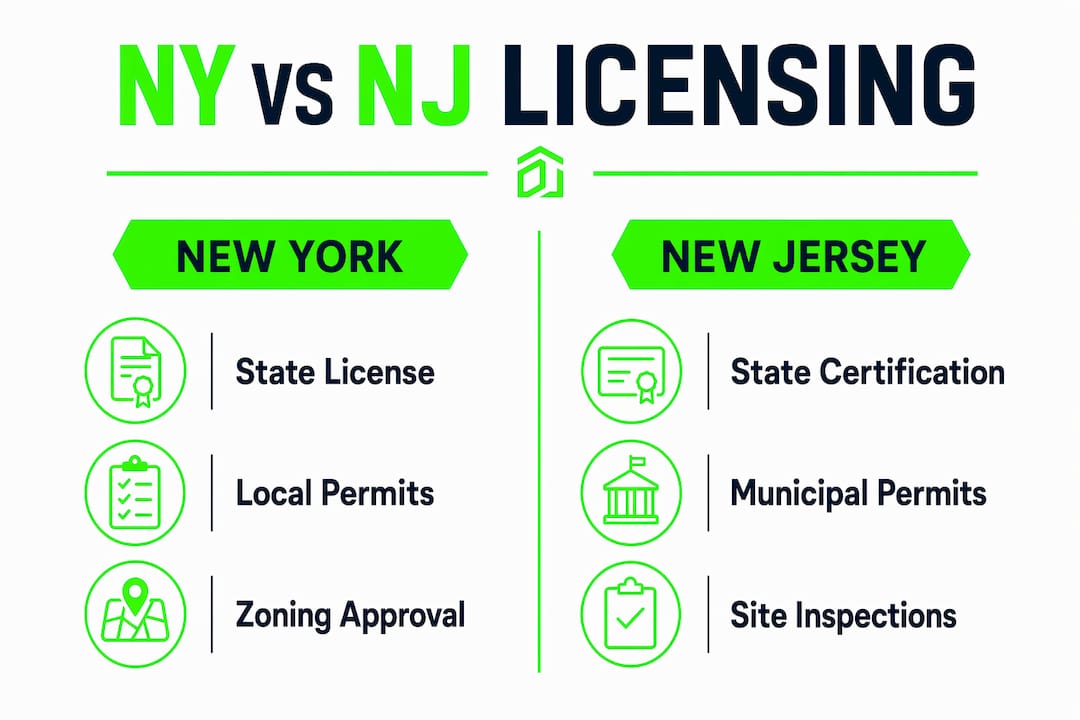
State level: New York and New Jersey both require contractors to hold state-issued trade licenses for electrical, plumbing, and HVAC work. These are professional licenses tied to the individual or company, not the property.
County level: Counties may require health department permits, environmental clearances, or county-specific contractor registrations depending on the scope of work and the property type.
City or municipal level: This is where building permits, zoning approvals, signage permits, and certificates of occupancy originate. NYC’s Department of Buildings and NJ’s local construction offices each have their own application portals, fee schedules, and inspection timelines.
Compliance with one jurisdiction does not satisfy the others. Holding a valid New York state contractor license does not exempt you from pulling a building permit in Brooklyn or registering with a county office in Nassau. Each layer requires its own application, fee, and approval.
Federal licenses rarely apply to standard residential or commercial renovation work. The exception is projects that involve federally regulated materials such as asbestos abatement or work on federally owned property, both of which trigger EPA and OSHA compliance requirements on top of local permits.
Pro Tip: Map every jurisdiction that applies to your property before you apply for anything. Write down the state, county, and municipality, then visit each government website separately. This prevents the most common mistake: assuming state compliance covers everything.
What mistakes do owners commonly make with local licensing?
The most costly licensing mistakes are not about ignorance of the law. They are about sequence, scope, and tracking. Owners who understand the rules still get tripped up by the order in which they apply.
Common pitfalls include:
Skipping zoning verification: Zoning restrictions often dictate parking, signage, customer visits, and operating hours. Signing a lease or starting work before confirming the zoning classification is the leading cause of licensing failure for home-based and small commercial businesses.
Applying for permits in the wrong order: A business license is usually a prerequisite to obtaining trade or operational permits. Submitting a plumbing permit application before the general business license is approved often results in rejection or processing delays.
Assuming state compliance is enough: Many owners who hold a valid state contractor license skip city-level permit applications. That assumption leads to stop-work orders and fines.
Missing renewal deadlines: Licenses lapse when renewal dates are missed. A lapsed license can void your insurance coverage and expose you to penalties on active projects.
Overlooking county requirements: County-level permits, especially environmental and health department approvals, are frequently missed because owners focus only on city and state requirements.
Local governments often require detailed information about business operations, employees, and facilities as part of the permit application. That level of detail catches many owners off guard, especially on first-time renovation projects.
How do you research and apply for local licenses in NY and NJ?
A systematic approach to the permit and license process prevents the delays that derail projects. Follow this sequence for any construction or renovation project in New York or New Jersey:
Confirm your zoning classification. Visit your city or county zoning office website and verify the permitted uses for your property address. In NYC, the NYC Zoning Resolution and the Department of City Planning portal are the primary resources.
Identify every applicable jurisdiction. List the state, county, and municipality for your project address. Each one may require separate registrations or permits.
Apply for your general business license first. The business license is the prerequisite for most trade and operational permits. In New Jersey, the Division of Revenue and Enterprise Services handles business registration. In New York, the Department of State handles entity registration.
Pull trade permits from the correct local office. Building permits in NYC come from the Department of Buildings. In NJ, they come from the local construction official in your municipality. Electrical and plumbing permits are issued separately.
Gather required documentation before applying. Local governments often require detailed information including proof of insurance, contractor license numbers, site plans, and property ownership documents.
Schedule inspections proactively. Most permits require one or more inspections before the work is approved. Build inspection windows into your project timeline, not as an afterthought.
Track every license and renewal date in one document. Maintaining a centralized license tracking document listing all jurisdictions, approval dates, and renewal deadlines is the most effective way to stay compliant across a multi-permit project.
Understanding how to identify a licensed contractor before hiring is equally important. Verifying that your contractor holds valid state and local licenses protects you from liability if unpermitted work is discovered during a sale or inspection.
For a detailed breakdown of what each permit stage involves, Djcustomcontracting’s guide on construction project stages walks through compliance checkpoints from pre-construction through final inspection.
Key Takeaways
Navigating local licensing in New York and New Jersey requires satisfying independent permit requirements at the state, county, and city level before any construction or renovation work begins.
Point | Details |
Permits are project-specific | Building, electrical, plumbing, and zoning permits are separate approvals, each from a different office. |
Jurisdictions are independent | State compliance does not satisfy county or city requirements; each layer requires its own application. |
Sequence matters | Apply for a general business license before trade or operational permits to avoid rejection. |
Zoning is the first check | Verify zoning classification before signing a lease or starting any work to prevent project failure. |
Track renewals centrally | A single document listing all licenses, approval dates, and renewal deadlines prevents costly lapses. |
What I’ve learned from years of navigating NY and NJ permits
The part of licensing that trips up even experienced owners is not the paperwork. It is the assumption that one approval covers everything. I have seen projects in Queens get stopped because the contractor had a valid state license but never pulled a city building permit. I have seen NJ commercial renovations stall for weeks because the owner applied for a plumbing permit before the business license was processed. Both situations were avoidable.
What I tell every client before we start: map your jurisdictions on day one. Write down every government body that has authority over your property and your project type. Then treat each one as a separate task with its own deadline. That discipline alone eliminates the majority of compliance problems I see in the field.
The other thing most articles do not say plainly: permits protect you as much as they protect the public. A permitted renovation is documented, inspected, and legally defensible. An unpermitted one creates problems at resale, during insurance claims, and whenever a future owner pulls a permit and the inspector finds prior work that was never approved. The short-term inconvenience of pulling permits is nothing compared to the long-term cost of skipping them.
— DJ
How Djcustomcontracting supports your licensing and compliance process
Djcustomcontracting has managed licensing and permitting for residential and commercial projects across New York and New Jersey since 2018. Every project the team handles is executed in accordance with applicable local laws, building codes, and insurance regulations.

Whether you are planning a full interior renovation, an exterior addition, or a commercial buildout, Djcustomcontracting coordinates the permit applications, inspection scheduling, and compliance documentation so your project stays on track. The team also handles DOB and DOT violation removal for properties with existing compliance issues. For owners ready to move forward, Djcustomcontracting’s commercial renovation services cover every stage from permit acquisition through final inspection in NY and NJ.
FAQ
What is a local licensing requirement for construction?
A local licensing requirement is a permit or approval issued by a city, county, or state authority that must be obtained before construction or renovation work can legally proceed. Requirements vary by jurisdiction and project type.
Do I need separate permits for electrical and plumbing work in NY and NJ?
Yes. Electrical and plumbing permits are issued separately from building permits and must be obtained from the local authority having jurisdiction over your property. Combining them into one application is not permitted.
What happens if I start construction without the required permits?
Unpermitted work can result in stop-work orders, fines, and mandatory removal of completed work. It also creates legal and financial complications during property sales and insurance claims.
How long does it take to get a building permit in New York or New Jersey?
Permitting reviews for significant commercial renovation projects can take a month or longer. Residential permits may process faster, but timelines depend on the municipality and the completeness of your application.
Does holding a state contractor license mean I do not need local permits?
No. A state contractor license and a local building permit are separate requirements. Compliance with one jurisdiction does not satisfy the others, and local permits must be pulled for every project regardless of state licensing status.
Recommended


Comments