


What Are Building Codes? A Guide for NY & NJ Owners


Building codes are legally enforceable regulations that set minimum standards for how buildings must be designed, constructed, and maintained to protect the safety, health, and welfare of occupants. In the United States, no single federal code governs construction. Instead, states and municipalities adopt national model codes like the International Building Code (IBC) and the International Residential Code (IRC), then amend them to fit local conditions. For property owners in New York and New Jersey, understanding building codes is the first step toward avoiding costly violations, failed inspections, and project delays.
What are building codes and what do they cover?
Building codes are the legal foundation of every construction project. They define the minimum acceptable standards for structural design, fire safety, energy efficiency, mechanical systems, and occupant accessibility. A building that meets code is not just legally compliant. It is built to protect the people inside it.
Building code compliance is enforced through a permitting process managed by local Authorities Having Jurisdiction (AHJs). In New York City, that authority is the Department of Buildings (DOB). In New Jersey, enforcement falls to municipal construction officials operating under the New Jersey Uniform Construction Code (UCC). Both states adopt and modify national model codes, which means the rules you follow in Newark differ from those in Manhattan or Jersey City.
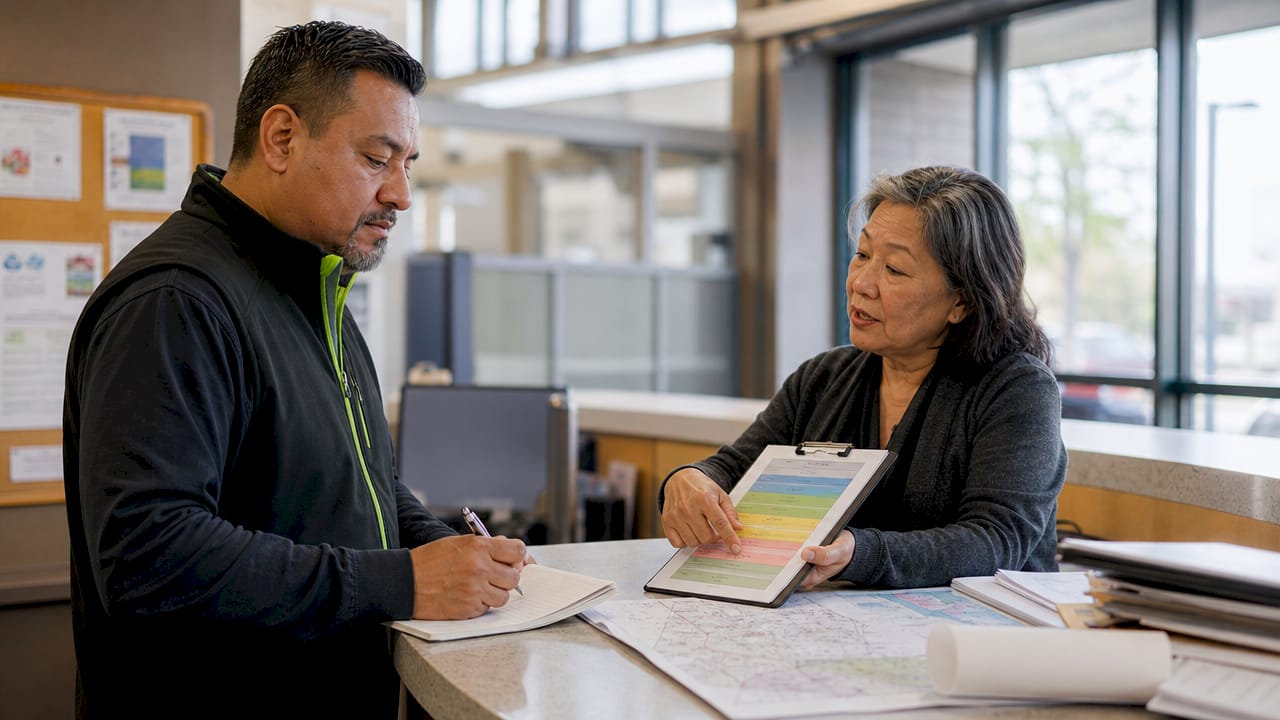
FEMA states that adopting up-to-date building codes is the single most important factor in reducing death and property damage during earthquakes. The agency puts it plainly: earthquakes do not kill people, buildings do. That principle applies beyond seismic risk. Properly coded buildings resist fire spread, structural failure, and environmental hazards far better than those built without oversight.
What are the primary domains covered by building codes?
Building codes regulate five primary technical areas. Each area addresses a different category of risk, and each carries its own set of rules, standards, and inspection checkpoints.
Structural integrity: Load-bearing requirements govern how a building handles weight from occupants, furniture, snow, wind, and seismic forces. Structural design checks verify that foundations, framing, and connections meet minimum safety thresholds.
Fire and life safety: Codes specify egress routes, fire-rated assemblies, sprinkler systems, and alarm requirements. Fire safety code compliance is not optional. Non-compliance exposes property owners to liability, fines, and insurance denial.
Energy efficiency: New York and New Jersey both enforce energy codes based on the International Energy Conservation Code (IECC). These rules govern insulation, window performance, HVAC efficiency, and lighting.
Mechanical and plumbing systems: Codes set standards for ventilation, heating, cooling, water supply, and drainage. These systems must be sized and installed correctly to prevent health hazards like carbon monoxide buildup or sewage backflow.
Accessibility: The Americans with Disabilities Act (ADA) standards are incorporated into building codes for commercial properties. Ramps, door widths, restroom configurations, and parking layouts all fall under this domain.
One area that often causes confusion is electrical work. Electrical standards are governed by the National Electrical Code (NEC), which operates alongside building codes as a separate but equally enforceable document. A building can pass a structural inspection and still fail an electrical one.
Pro Tip: When planning a renovation, request a pre-application meeting with your local AHJ. Many New York City DOB offices and New Jersey municipal construction departments offer this service. It costs nothing and can prevent weeks of plan revision.
How are building codes adopted and enforced in New York and New Jersey?
The code adoption process in the United States follows a multi-tier structure. Understanding it helps property owners know exactly who has authority over their project.
National model codes are published. Organizations like the International Code Council (ICC) publish the IBC, IRC, and related codes on a regular update cycle.
States adopt and amend. New York State adopts the New York State Building Code, which is based on the IBC with significant local amendments. New Jersey enforces the NJ UCC, which similarly draws from national models but includes state-specific modifications.
Municipalities add local rules. New York City operates under the NYC Construction Codes, a set of local laws that go beyond state requirements. Jersey City, Newark, and other NJ municipalities may add further local amendments on top of state rules.
AHJs issue permits and conduct inspections. No work covered by code can legally begin without a permit. The AHJ reviews submitted plans, issues the permit, and schedules inspections at key project milestones.
Final inspection and certificate of occupancy. Once all inspections pass, the AHJ issues a certificate of occupancy (CO) or certificate of completion. Without this document, a building cannot legally be occupied or sold.
Permit fees vary widely depending on project scope and municipality, ranging from a few hundred dollars for minor residential work to five figures for large commercial projects. That cost is minor compared to the fines and stop-work orders that follow unpermitted construction.
A critical mistake property owners make is referencing national model codes without checking local amendments. Local amendments are common and frequently cause plan rejections when contractors submit drawings based on the raw IBC or IRC. Always verify the current adopted code version with your local building department before submitting plans.
Pro Tip: In New York City, you can look up active permits, violations, and inspection records through the NYC DOB NOW portal. In New Jersey, the Division of Codes and Standards maintains a searchable database of adopted code editions by municipality.
Building codes versus zoning codes: what is the difference?
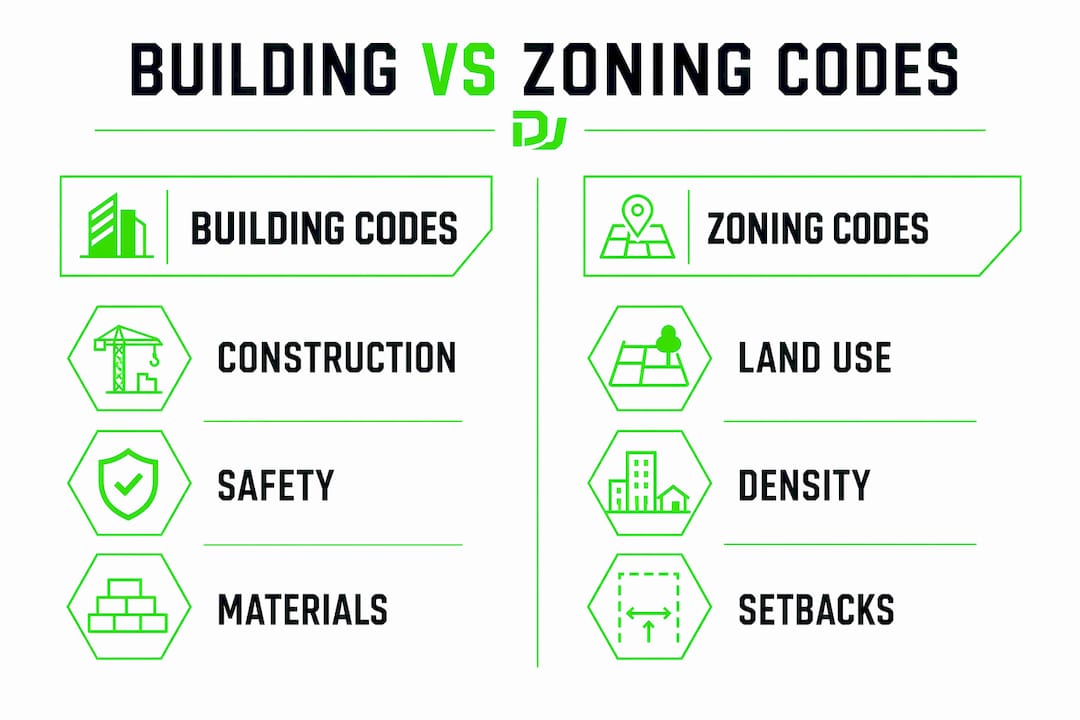
Building codes and zoning codes are two separate legal frameworks. Confusing them is one of the most common and costly mistakes property owners make.
Feature | Building codes | Zoning codes |
What they regulate | How a building is constructed | Where and what type of building can be placed |
Primary concern | Safety, structural integrity, fire protection | Land use, density, setbacks, height limits |
Who enforces them | Building department / AHJ | Zoning board / planning department |
When they apply | During design, construction, and occupancy | Before design begins |
Approval type | Building permit and inspections | Zoning variance or use permit |
Zoning approval does not guarantee building code approval. A property owner in Brooklyn might receive zoning approval to add a second floor to a commercial building, then discover the structural system does not meet code requirements for the added load. Both approvals are required, and they come from different offices with different review criteria.
In New Jersey, a homeowner in Hoboken might get zoning clearance to convert a garage into a living space, only to find the project requires fire separation walls, egress windows, and mechanical upgrades that significantly change the project budget. Understanding both codes before design begins prevents these surprises. For owners planning additions, reviewing how to plan building additions in New York and New Jersey provides a practical starting point.
What practical steps should property owners take for building code compliance?
Building code compliance does not happen by accident. It requires deliberate planning from the earliest stage of a project.
Know what requires a permit. Permitting requirements extend well beyond new construction. Major electrical and plumbing work, structural alterations, decks, pools, solar panel installations, and HVAC replacements all typically require permits. Skipping a permit risks fines, stop-work orders, and mandatory removal of completed work.
Work with a contractor who knows local codes. A general contractor experienced in New York and New Jersey construction will know which version of the code is currently adopted in your municipality. The benefits of hiring a general contractor include code familiarity, permit management, and coordination with inspectors. This expertise reduces the risk of costly rework.
Submit complete plans before work starts. Incomplete plan submissions are the leading cause of permit delays. Plans must include architectural drawings, structural calculations where required, and specifications for materials and systems. In New York City, many projects require a licensed architect or engineer to file plans with the DOB.
Schedule and pass all required inspections. Inspections happen at defined milestones: foundation, framing, rough mechanical and electrical, and final. Missing an inspection or covering work before it is inspected can result in the AHJ requiring demolition of completed work to verify compliance underneath.
Keep all permits and records. Permits, inspection sign-offs, and certificates of occupancy are permanent property records. They are required during real estate transactions and insurance claims. Losing them creates delays and legal complications. For NYC property owners, a practical reference for staying on top of these requirements is the NYC homeowner compliance guide.
Building code compliance is a strategic economic investment that yields returns through higher property values and reduced liability exposure. Compliance protects your asset, not just your occupants.
Key takeaways
Building codes are legally enforceable regulations that govern construction standards, and compliance in New York and New Jersey requires understanding both state-adopted codes and local amendments before any project begins.
Point | Details |
Definition of building codes | Building codes set minimum legal standards for construction safety, health, and welfare. |
Five regulated domains | Codes cover structural integrity, fire safety, energy efficiency, mechanical systems, and accessibility. |
Local amendments matter | New York and New Jersey both amend national model codes; always verify current local requirements. |
Permits are mandatory | Permitting applies to renovations, additions, electrical work, pools, and solar installations, not just new builds. |
Codes differ from zoning | Zoning approval and building code approval are separate processes requiring separate applications. |
My take on building codes after years of working in New York and New Jersey
Building codes are a blueprint for safety and accountability, not obstacles to getting work done. That framing matters because I have seen property owners treat the permitting process as an inconvenience to minimize. That approach almost always costs more in the end.
The most consistent problem I see in New York and New Jersey is owners or contractors referencing outdated code editions. New York City updates its construction codes on its own cycle, and New Jersey municipalities sometimes lag behind state adoption schedules. Submitting plans based on the wrong code version triggers rejections that delay projects by weeks. A five-minute call to the local building department before design begins prevents that entirely.
The other insight worth sharing is this: early communication with your AHJ is the single most underused tool in construction compliance. Most building departments will tell you exactly what they need before you submit. They are not adversaries. They are the people who can tell you how to get your permit approved on the first submission.
Compliance is also a financial decision. Code-compliant buildings command higher property values and face fewer complications during sales, refinancing, and insurance claims. The cost of doing it right the first time is always lower than the cost of correcting violations after the fact.
— DJ
Djcustomcontracting: your partner for code-compliant projects in NY and NJ
Property owners in New York and New Jersey face some of the most detailed and frequently updated building regulations in the country. Navigating permits, inspections, and local amendments takes time and expertise that most owners do not have on hand.

Djcustomcontracting has been delivering code-compliant residential and commercial construction since 2018. From commercial renovations in NY and NJ to DOB violation removal and building maintenance, every project is managed in accordance with applicable local laws, licensing requirements, and building codes. Whether you are planning a full interior renovation or need help resolving an existing violation, Djcustomcontracting handles the permitting process and coordinates with local authorities so your project moves forward without costly interruptions. Reach out to discuss your project and get a clear picture of what compliance requires for your specific property.
FAQ
What are building codes in simple terms?
Building codes are legally enforceable rules that set minimum standards for how buildings must be designed, built, and maintained to protect the safety and health of occupants.
Do building codes differ between New York and New Jersey?
Yes. New York State and New York City each maintain their own adopted code versions with local amendments. New Jersey enforces the NJ Uniform Construction Code, which also includes state-specific modifications to national model codes.
What happens if you build without a permit?
Building without a required permit can result in fines, stop-work orders, and mandatory removal of completed work. It can also complicate property sales and insurance claims.
Are building codes and zoning codes the same thing?
No. Building codes regulate how construction is done. Zoning codes regulate where and what type of structure can be built. Both approvals are required, and they come from separate government offices.
What types of projects require a building permit?
Permits are required for new construction, additions, structural alterations, major electrical and plumbing work, deck and pool installations, and solar panel systems. Minor cosmetic work typically does not require a permit, but checking with your local AHJ first is always the right call.
Recommended


Comments