


NYC Property Upgrades: A Practical Guide for Owners


A guide to property upgrades in NYC is defined as a structured process for improving residential or commercial spaces in compliance with New York City’s building codes, permit requirements, and board approval rules. NYC properties face unique constraints: co-op and condo boards, the NYC Department of Buildings (DOB), and the Landmarks Preservation Commission (LPC) all shape what you can do and when. Getting the sequence right, permits first, contractor second, construction third, determines whether your project finishes on time and within budget. Djcustomcontracting has worked through this process on projects of every scale since 2018, and the lessons are consistent.
What permits and approvals are required for property upgrades in NYC?
Most structural, electrical, plumbing, and mechanical work in NYC requires a DOB permit before any tools touch the property. Cosmetic work, such as painting or replacing fixtures with like-for-like units, often does not. The line between the two is sharper than most owners expect.
DOB NOW filing is the standard submission path for most alteration projects. Standard approvals typically take 3–8 weeks. Projects that fall within a Landmarks Preservation Commission review area can add 3–6 months to that timeline. That gap matters enormously for scheduling.

Co-op and condo buildings add another layer. Before the DOB even sees your application, your building’s alteration agreement must be signed and approved by the board. Most alteration agreements restrict work hours to 9 AM–4 PM on weekdays, set insurance requirements, and require damage deposits ranging from $500 to $5,000 or more. These rules are building-specific and often stricter than city code.
Pro Tip: Start your board approval process 6–8 weeks before you plan to file with the DOB. Board timelines are unpredictable, and a delayed approval pushes every downstream date.
Key permit categories for NYC property upgrades include:
Alteration Type 1 (Alt-1): Change of use, occupancy, or egress. Requires full plan examination.
Alteration Type 2 (Alt-2): Multiple work types that don’t change use or occupancy. Common for kitchen and bathroom gut renovations.
Alteration Type 3 (Alt-3): Single work type, limited scope. Fastest approval path.
Plumbing and electrical permits: Filed separately from structural alterations, even on the same project.
LPC Certificate of Appropriateness: Required for any exterior change to a landmarked building or within a historic district.
Understanding which category your project falls into determines your filing path, your timeline, and your total cost. Misclassifying an Alt-2 as an Alt-3 is a common mistake that triggers stop-work orders.
For door and entry upgrades specifically, Brooklyn permit requirements illustrate how even seemingly minor installations can trigger DOB filings. Fire door replacements carry their own compliance requirements under NYC building and fire codes.
How to budget and plan your NYC property upgrade effectively
Budgeting for NYC renovations requires accounting for costs that don’t exist in most other markets. Labor rates, permit fees, material delivery logistics, and building-specific fees all push project costs above national averages.
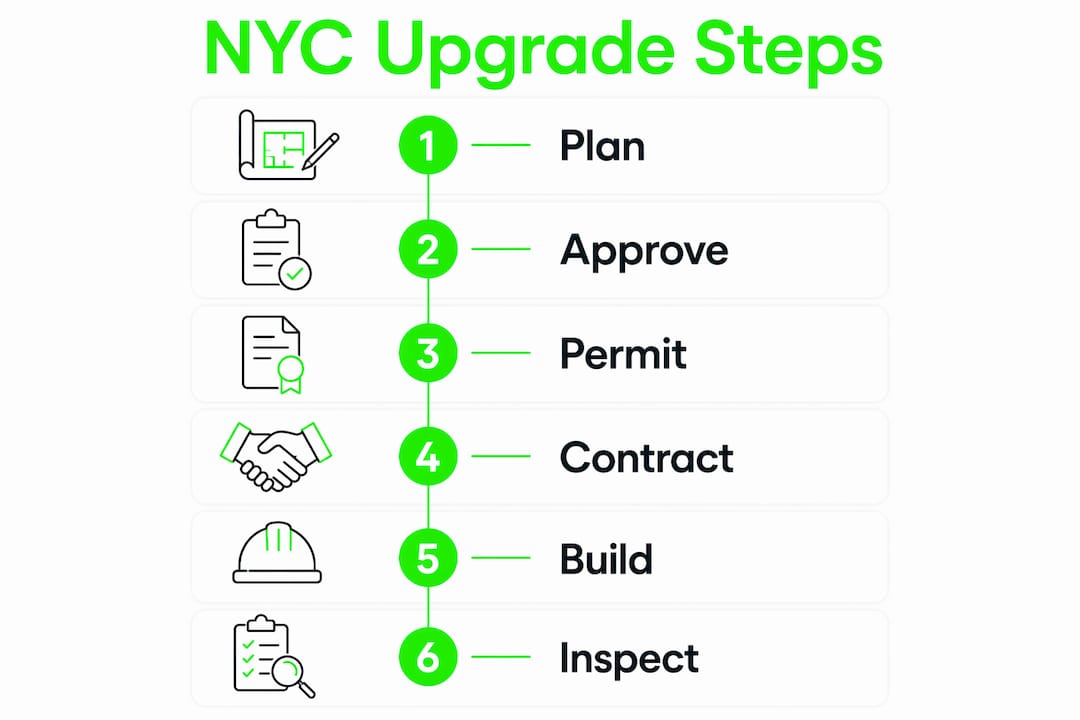
Experts recommend adding a 10–15% contingency buffer to every renovation budget. That buffer covers material price changes, hidden structural issues, and delays caused by building management rules. Skipping it is the single most common reason projects stall mid-construction.
Realistic budget planning for NYC upgrades follows this sequence:
Define the full scope in writing. Vague scopes produce vague bids. List every room, every finish, and every system you intend to touch before requesting contractor quotes.
Get three itemized bids. Line-item bids reveal where contractors differ on labor versus materials. Lump-sum bids hide those differences.
Add permit and filing fees. DOB filing fees vary by project type and square footage. Budget $500–$3,000 for most residential alterations, more for commercial work.
Factor in building-specific costs. Alteration agreement deposits, freight elevator scheduling fees, and required building protection materials are real costs that many owners miss entirely.
Build in the contingency. Apply the 10–15% buffer after all other line items are totaled, not before.
Plan for timeline-related carrying costs. If you’re financing the project or paying rent elsewhere during construction, a delayed finish costs real money. Understanding the financial impact of a NYC renovation helps you plan for those carrying costs accurately.
Pro Tip: Request a copy of your building’s alteration agreement before you finalize your budget. The deposit requirements and insurance minimums in that document directly affect your upfront cash needs.
Typical project timelines give you a planning baseline: a cosmetic refresh runs 2–4 weeks, a bathroom renovation 4–8 weeks, a kitchen remodel 6–10 weeks, and a full gut renovation 12–20 weeks. Add 4–8 weeks for board approvals, DOB permits, and material delays on top of those figures.
How do you choose and manage a contractor for NYC upgrades?
The contractor you hire determines whether your project complies with NYC law. Every contractor performing home improvement work in NYC must hold a Home Improvement Contractor (HIC) license issued by the NYC Department of Consumer and Worker Protection. Proof of insurance naming the building as an additional insured is mandatory for most co-op and condo alteration agreements.
Verification steps before signing any contract:
Confirm the HIC license number on the NYC Department of Consumer and Worker Protection website.
Check the contractor’s DOB compliance history for open violations or stop-work orders.
Request a certificate of insurance and verify the policy is active and covers the full project value.
Ask for three references from projects completed in NYC buildings similar to yours.
Review the contractor’s experience with your specific building type, co-op, condo, or commercial.
Pro Tip: Ask your building’s super or property manager for contractor recommendations. They know which contractors follow building rules and which ones cause problems.
A proper renovation contract must list exact material grades, include a payment schedule with no more than 30% upfront, and detail the change order process in writing. Contractor resistance to written documentation is a clear warning sign. Verbal agreements have no legal standing in NYC renovation disputes. For a full breakdown of what to watch for, NYC contractor red flags covers the most common scams and how to avoid them.
What upgrades offer the best return on investment in NYC properties?
Capital improvements like HVAC upgrades, insulation, roofing, elevator modernization, and facade work consistently outperform cosmetic changes in long-term value. They reduce operating costs, satisfy energy compliance laws, and increase buyer and tenant appeal. That combination is hard to match with paint and new countertops alone.
Energy-efficient upgrades including LED lighting, electrical panel modernization, and motion sensors reduce operating expenses directly. High utility costs in NYC make these upgrades pay back faster than in lower-cost markets. They also position properties well for NYC’s Local Law 97 compliance requirements, which impose carbon emission limits on larger buildings.
High-value upgrades by category:
Mechanical and structural: HVAC replacement, boiler upgrades, electrical panel modernization, roof replacement, waterproofing.
Kitchen and bathroom: Full gut renovations with updated plumbing and electrical, not just cosmetic resurfacing.
Lighting and electrical: LED conversion, smart controls, panel capacity increases for EV charging or modern appliances.
Flooring: Hardwood installation or refinishing, which holds value better than carpet or laminate in NYC resale markets.
Building envelope: Window replacement, facade repair, and insulation upgrades that reduce heat loss and noise.
The distinction between cosmetic and functional upgrades matters for co-op and condo owners specifically. Boards often scrutinize functional changes more closely because they affect building systems. Understanding co-op vs. condo renovation differences helps you anticipate board concerns before your application reaches the review stage.
For fire safety compliance, fire door replacement is a functional upgrade that satisfies DOB and FDNY requirements while improving building safety ratings. It is often required rather than optional in older NYC buildings.
Key takeaways
Effective NYC property upgrades require permits, board approvals, a contingency budget, and a licensed contractor before any construction begins.
Point | Details |
Permits come first | File DOB permits and secure board approvals 6–8 weeks before construction starts. |
Budget for the unexpected | Add a 10–15% contingency buffer to cover hidden costs and building-specific fees. |
Verify your contractor | Confirm the HIC license, active insurance, and DOB compliance history before signing. |
Prioritize capital improvements | HVAC, roofing, and electrical upgrades deliver stronger long-term returns than cosmetic changes. |
Document everything | Written contracts, material specs, and change orders protect you if disputes arise. |
What I’ve learned after years of NYC renovation projects
The owners who finish on time and on budget share one habit: they treat the planning phase as the real work. By the time a hammer swings, every permit is filed, every board approval is signed, and every material is on order. That level of preparation feels excessive until you watch a project stall for six weeks because a board approval was submitted late.
The other pattern I see consistently is owners underestimating how much the building itself controls the project. Alteration agreements are not formalities. They contain punitive clauses, strict working hour limits, and deposit requirements that can run into thousands of dollars. Reading that document before you budget is not optional.
Contractor selection is where I see the most avoidable damage. A contractor who won’t provide a written scope, itemized payment schedule, and change order process in writing is not a contractor you want inside your property. The paperwork is not bureaucracy. It is your only protection when something goes wrong, and something always does.
My honest advice: spend more time on the front end than feels necessary. The owners who rush into construction to save a few weeks almost always spend more time and money fixing problems than the careful planners ever did.
— DJ
Djcustomcontracting’s approach to NYC property upgrades
Djcustomcontracting has been handling residential and commercial renovations across New York City since 2018. The team manages every stage of a project, from initial scope development and permit filing through construction and final inspection.

Whether you need a commercial renovation contractor for a full buildout or a licensed team to manage a residential alteration from DOB filing to punch list, Djcustomcontracting brings the NYC-specific knowledge your project requires. No job is too large or too small. Contact Djcustomcontracting to discuss your project scope and get a clear plan before construction begins.
FAQ
What permits does a NYC property upgrade require?
Most structural, electrical, plumbing, and mechanical work requires a DOB permit filed through DOB NOW. Co-op and condo buildings also require a signed alteration agreement from the board before work begins.
How long does a NYC renovation permit take to approve?
Standard DOB NOW approvals take 3–8 weeks. Projects requiring Landmarks Preservation Commission review can take an additional 3–6 months, so plan accordingly.
What is a Home Improvement Contractor license in NYC?
An HIC license is issued by the NYC Department of Consumer and Worker Protection and is legally required for any contractor performing home improvement work in New York City.
How much contingency should I add to my NYC renovation budget?
Add 10–15% above your total project cost to cover unexpected expenses including material price changes, hidden structural issues, and building management delays.
What upgrades add the most value to NYC properties?
Capital improvements like HVAC replacement, electrical modernization, roofing, and energy-efficient lighting consistently outperform cosmetic upgrades in long-term property value and operating cost reduction.
Recommended


Comments